

How to seize control of your career story in the productivity phase of AI.
We’re more than halfway through 2026 — and we’re indeed managing in the age of AI.
We’re on track to see about 40 percent of all teams adopting autonomous agents working side-by-side with their human counterparts this year. In 2027, more than half of all teams will incorporate agents.
In 2025, AI seemed like an all-encompassing threat to human employment — it was hard to envision the difference between a chat bot and an agent, let alone this thing called agentic. All this stuff was new, and it wasn’t like a piece of hardware you could hold in your hands.
It’s getting clearer now, as we approach the second half of 2026, that AI is fueling a productivity revolution, not a remove-all-the-humans revolution — at least for now. My interview with Salesforce’s Blake Wood showed the incredible impact of AI-based agents on personal and team productivity — so much so that the agents are literally making it easier for their human teammates to “sleep at night.” I’ve gotten notes from readers saying similar things.
This is the phase of AI adoption we’re in. It could last a year, but who really knows.
Except we know this: we’re in the productivity phase.
I’m in full optimist mode. Now is the time to seize control of the one thing we all control: our career story in the productivity phase of AI.
I’m so lucky to meet and discuss managing with some incredible thinkers in this newsletter. In the last year, two big ideas stood out in particular.
The first big idea came from from Patti Sanchez and her Three-Act Story model. The second big idea came from my recent interview with Kari Zeller and her framework for constructing a future version of ourselves.
My goal in this newsletter is to “connect the dots” between all these big ideas and my own thinking to help managers with career conversations, starting with this assumption:
This phase of AI is grounded in one fundamental principle: autonomous agents driving productivity are at the heart of every great career story.
I built a three-step framework to facilitate these conversations, combining the best of my thinking with Kari and Patti’s.
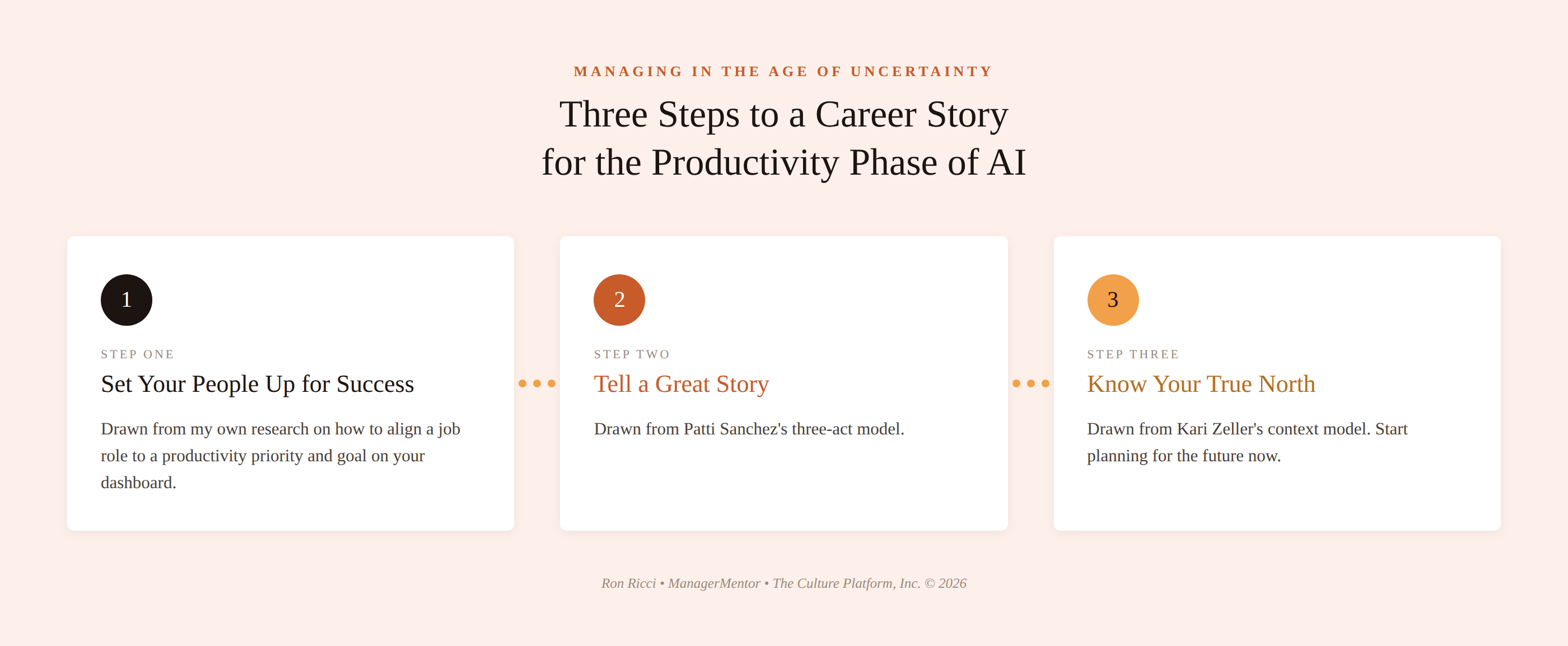
STEP ONE: Set your people up for success
This is why I love managing people: you have responsibilities and you have resources. You can make things happen for your people — and yourself. It’s your job to align people and budgets for high performance execution — and help set your team up for success.
In this phase of AI, where are your productivity BHAGs (big, hairy audacious goals) on your dashboard? What parts of your responsibilities are most likely to leverage agents for productivity?
Play to someone’s strengths
Make sure every person managing an agent is doing work that reflects their abilities. All experienced managers know you should never play to someone’s weaknesses in a job role. When someone’s job role is a reflection of their strengths, it builds confidence in them to work even harder.Put names on your dashboard
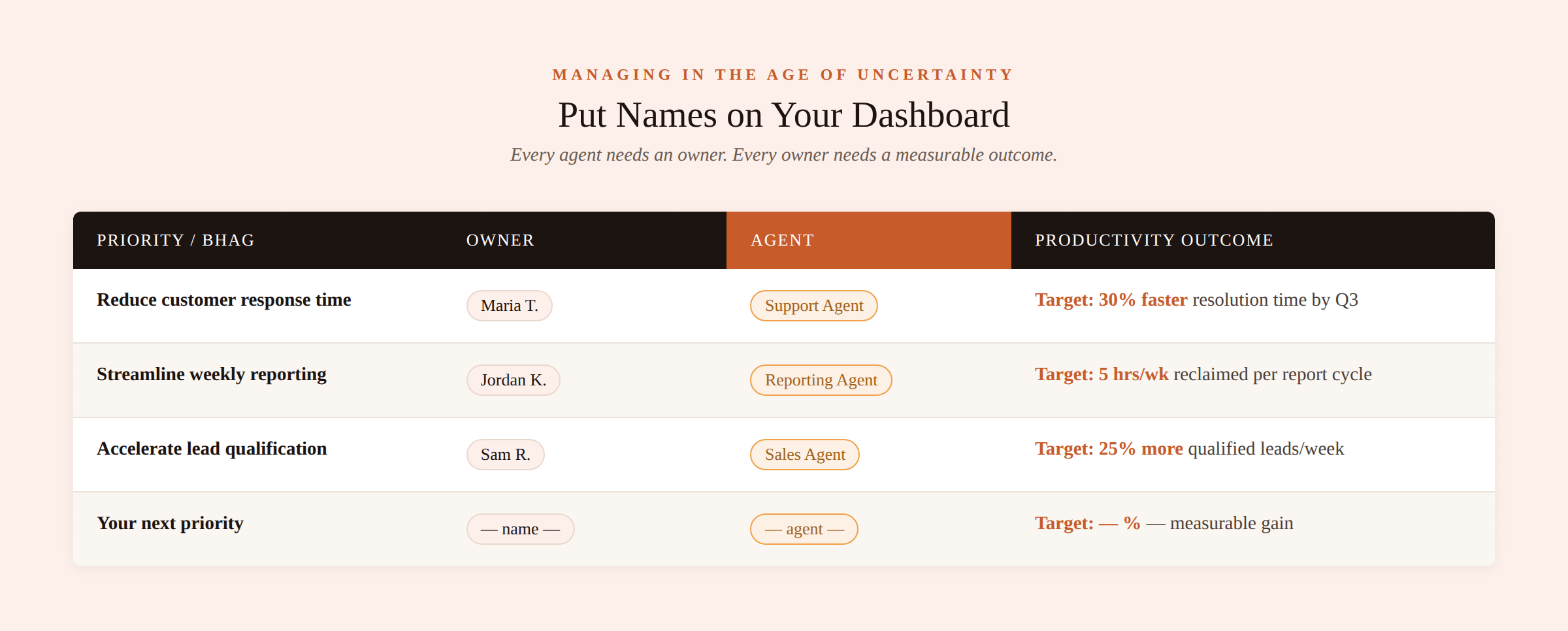
Make sure every agent exists on your dashboard. Do that by putting the names of people next to each agent. Someone on your team should literally be able to “hold” their box of responsibilities in their hands. Any job role on your team that does not have direct line of sight to your priorities, goals, and metrics is out of alignment.Make sure every agent has a measurable productivity outcome
From my experience at Cisco, productivity improvements at scale above 3-5% would be considered best-in-class. In the case of a productivity BHAG with an agent, expectations should be higher — much higher. Outsized productivity at the personal and team level should be expected….25/33/50 percent gains. The first phase of productivity is always highest.
STEP TWO: Tell a great story
Patti defines story as “a unit of information that has a particular structure to it.”
What I learned from her is the way a personal story follows the same structure that works in theater and film — three distinct, but connected acts: the beginning, the middle, and the end.
Patti advises taking one act at a time. “The mistake most people make is mushing all three together,” she told me. If you need the third act to make the first act great, you’re not writing a great story. Each act needs to stand on its own to compel people to want to hear how the story finishes.
To tell a great story about leveraging agents to drive a breakthrough, follow Patti’s three acts:
Act One — Establish Credibility: What productivity BHAG? What problem are you solving? No big wind-up or preamble. Act One is rooted in the main character — people and the agents they’re managing — establishing themselves: who they are and what makes them important.
Act Two — Differentiate Yourself: How does playing to your strengths come into play with a productivity BHAG? How are you as a person the best member of the team to drive the BHAG? Dive deeper into how you think and how you work. This act is grounded in your strengths — you can’t differentiate yourself if you’re not playing to what you genuinely do better than others.
Act Three — Leave a Memorable Vision: What will be the lasting impact of your productivity BHAG? Close with a vision that leaves people wanting to work with you. As Patti puts it: “A career story is like a person being a product, and your product is the way you think and the way you work. It’s your reputation.”
STEP THREE: Know your “true north”
Here’s what we know: the productivity phase of AI’s adoption won’t last long. Sometime in the next year, agents will evolve beyond personal and team productivity. Having a productivity-driven BHAG with an agent sets someone up to advance and grow.
But how do you plan for the future when the future isn’t here?
That’s what I learned from interviewing Kari and reading her new book, Re-Placed: Answering the Call of Leadership in the Age of AI. Her focus is on context — “the frame” someone constructs to see themselves in the future.
Context, in my view, is the way people find their “true north” in the age of AI — how you see yourself thriving in the AI economy from a career perspective.
Using Kari’s model, here are four questions a manager can share with their people to help them take a big picture view of themselves — and see a “true north” for their career.
Fundamental cares: What matters most to you right now — not just what you’re asking for, but what’s underneath it? Dignity, belonging, security, feeling like your work counts?
Meaningful contribution: Where do you feel like what you bring is actually needed — not just filling a slot, but something the team genuinely can’t do without?
Recognition: When your work makes a real difference, do you feel like people actually see it? What would it look like if they did?
Identity: Is this work helping you become someone you’re proud of? Are you growing into who you actually want to be?
HOMEWORK:
Career planning is not something most first-time managers are trained on, especially for gen-z and millennials.
In your next 1:1’s with your people, share this three-step framework and get feedback. Tell your people you want to help them write a great chapter of a career story on your team and set them up to advance in this phase of AI’s adoption. Ask your team what they think. Your people will love you for putting their story first.
See where you stand as a manager.
How consistent are you as a manager? Take the Self-assessment.
How to be a Great First-time Manager: The Culture Platform
The only purpose-built learning and development system for first-time millennial and gen-z managers.
The corporate ladder has been dismantled rung by rung by AI. For millennials and gen-z, the predictable career path has vaporized — and most managers are navigating it alone, without any formal training.
I’ve managed about 5,000 people in my career, and was consistently ranked in the top quartile of all managers at Cisco, one of the world’s best places to work. I’ve walked in your shoes as a manager.
I left Cisco to answer one question with research and evidence: what does the manager of the future look like?
My research — conducted with thousands of young people at companies like Amazon, Google, Disney, and DoorDash — identified Six Drivers of Consistency that separate great managers from the rest, with a 95% confidence interval.
That research became The Culture Platform: a complete learning and development system — Framework, Feedback, and Tools — purpose-built for first-time managers who want to separate themselves and be a great manager of high-performance teams.
ManagerMentor • All Rights Reserved • The Culture Platform, Inc. • 2026