

How to Be a More Consistent Manager: The Six Drivers That Matter Most to Millennials and Gen Z
Summary: The hardest part of being a consistent manager is walking the talk. The consistency between your words and actions is always the most difficult part of the job. Setting expectations is hard. Following through is even harder. Here's what my research found after talking to thousands of millennials and gen-z at companies like Amazon, Google, Disney, and DoorDash: consistency is the number one reason why millennials and gen-z recommend a manager to their colleagues or friends. It makes sense when you think about it — in a world where so much is uncertain, consistency is the exact opposite.
The Six Drivers of Consistency — Managing in the Age of Uncertainty
A research-backed series for first-time millennial and gen-z managers by Ron Ricci
[Overview: How to Be a More Consistent Manager] · [Accountability: How to Hold People Accountable Without Micromanaging] · [Process: How to Share Your Management Process With Your Team] · [Alignment: How to Align Your Team to Your Priorities] · [Listening: How to Listen to Your Employees Effectively] · [Mindset: How to Develop Your Management Style] · [Facts: How to Use Facts to Manage Your Team’s Performance]
Why Consistency?
The core philosophy of this newsletter is rooted in one idea: successful managers in this moment in time, for this generation of talent, need to be “career dot-connectors.”
Remember, the next-gen doesn’t expect to spend their entire career on your team — that’s an idea boomers grew up with. A job on your team is like a chapter in a career story to the current generation. If you want the best people on your team, you have to connect the dots between roles on the team and the career opportunities of the people working on the team.
But it takes consistency, according to my research. As I’ve said earlier, this isn’t a theory newsletter - I want to give you new and specific information.
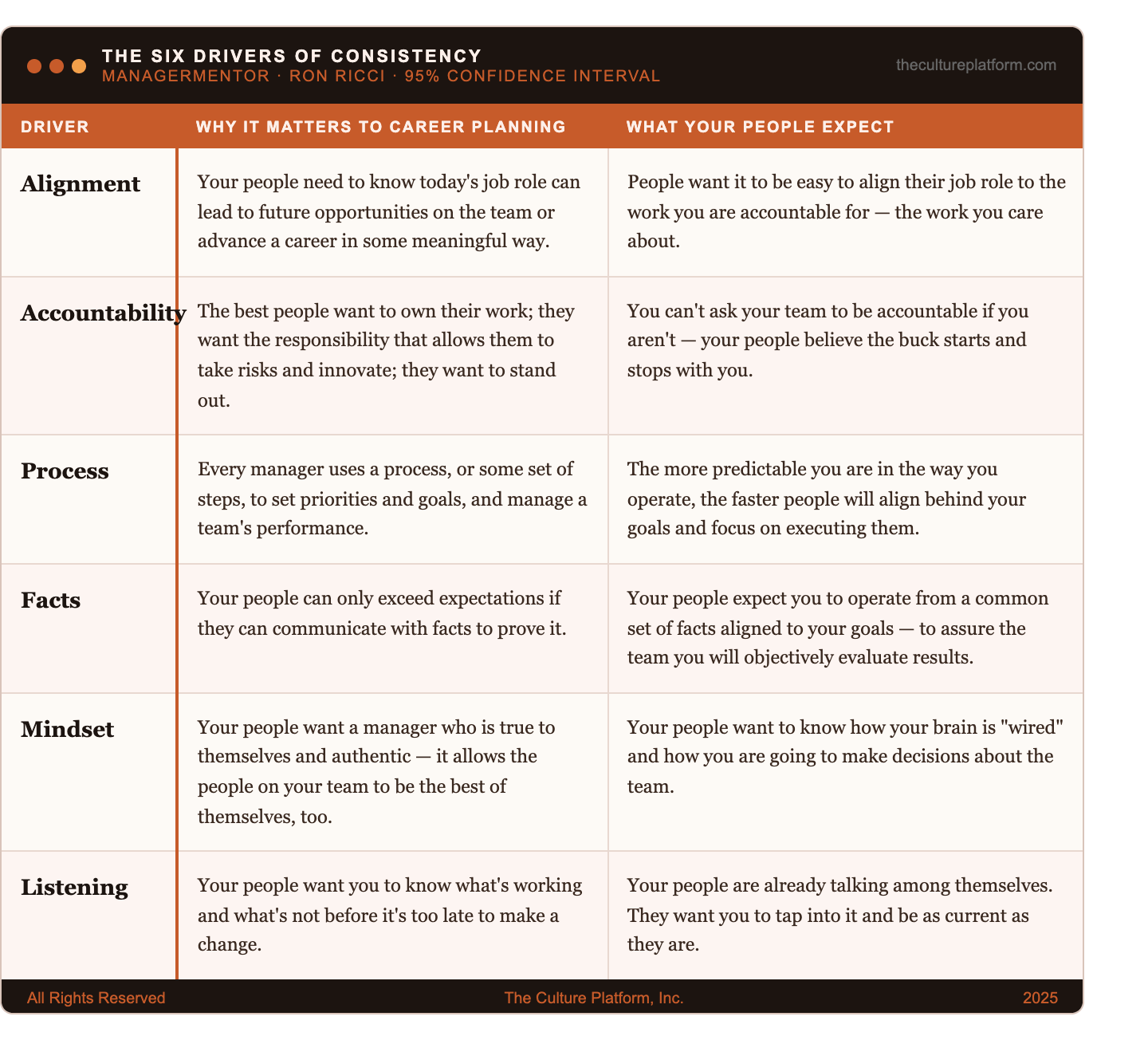
To that end, my research identified six specific “drivers” of consistency that millennials and genz care about. In research-speak, the Six Drivers have a 95% confidence interval in predicting someone’s willingness to recommend you as a manager — exactly the outcome you want.
At the highest level, these drivers pinpoint the exact skills you’ll need to be consistent in helping to connect career dots for your people. Look at the drivers are your starting point, the baseline skillset of anyone managing in the Age of Uncertainty.
The best people are looking for managers with these skills; people want to work for a manager who is both engaged in their career growth but also runs their team in a consistent way. Passive-aggressive behavior, where you do the opposite of what you say, is anathema to the current generation of talent. Boomers spent their entire careers living under the shadow of passive-aggressive outcomes.
The best people today want to know their manager can deliver on their word — because they are betting this chapter of their career on you
You don’t have to be great at all six of the Drivers of Consistency, but you have factor them into the way you manage the next generation of talent.
In the posts that follow, I drill down into each of the Six Drivers and the specific actions you can take as a first-time manager.
In this issue, I want to top-line the six drivers. As you read these, think about yourself as a manager. We all have strengths and weaknesses. You likely have instincts of where you excel when you look at the drivers or you may have already heard feedback where you could get better.
How consistent are you as a manager? Find out:
Why Inconsistency is the Biggest Mistake a First-Time Manager Can Make
I learned from feedback and my own failures that inconsistency is the enemy of being a great manager.
Earlier in my career, I wasn’t consistently accountable, and I wasn’t always the best with facts and process. It was invaluable feedback to hear. As a result of my openness to learning how to do better, I was ultimately given the opportunity to lead the largest sales enablement team at Cisco with hundreds of people and nearly $100 million annual operating budget, including data centers, sales labs and experience centers around the world.
Can you say the same about yourself? If you look at the Six Drivers of Consistency as the foundation of managing the next generation of talent, where are you? Ask your trusted advisors for feedback on yourself. Where do you need to get better with the Six Drivers?
Manager Thought of the Week
“I never get hard work confused with results.”
What former Cisco CEO John Chambers told me when I asked him the key to being a good manager. Accountability meant everything to John. I really enjoy John’s podcast on leadership.
How to be a Great First-time Manager: The Culture Platform
The only purpose-built learning and development system for first-time millennial and gen-z managers.
The corporate ladder has been dismantled rung by rung by AI. For millennials and gen-z, the predictable career path has vaporized — and most managers are navigating it alone, without any formal training.
I’ve managed about 5,000 people in my career, and was consistently ranked in the top quartile of all managers at Cisco, one of the world’s best places to work. I’ve walked in your shoes as a manager.
I left Cisco to answer one question with research and evidence: what does the manager of the future look like?
My research — conducted with thousands of young people at companies like Amazon, Google, Disney, and DoorDash — identified Six Drivers of Consistency that separate great managers from the rest, with a 95% confidence interval.
That research became The Culture Platform: a complete learning and development system — Framework, Feedback, and Tools — purpose-built for first-time managers who want to separate themselves and be a great manager of high-performance teams.
ManagerMentor • All Rights Reserved • The Culture Platform, Inc. • 2026
HI Ron !
This is powerful, motivating information. I'm not a manager of anyone or anything, other than my home and family. I think some of the ideas are certainly applicable even though I am no longer in the workforce. Thank you!