

Am I Predictable: How to Share Your Management Process with Your Team
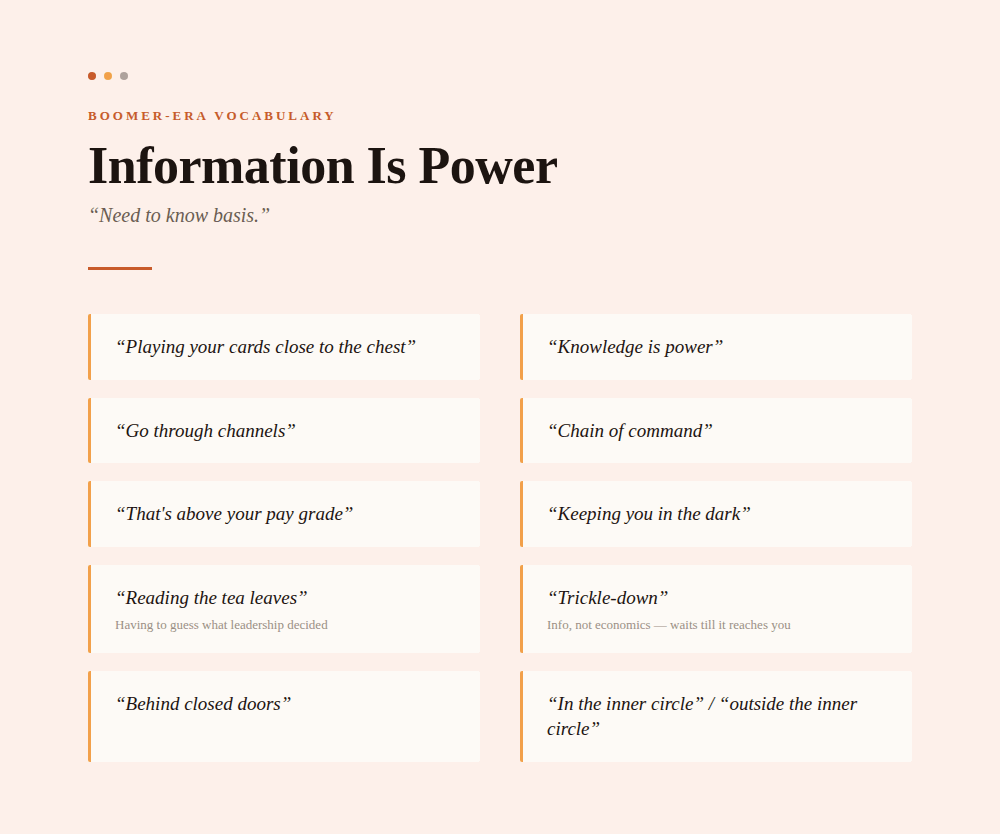
Back in the boomer era, “information was power.” That’s because top-down, command-and-control management structures literally kept all the important information in the hands of a few people.
Of course, that’s the genesis of “corporate politics,” making it almost impossible to be a predictable manager.
Sharing information was a no-no. Thus, the birth of phrases like “keep your cards close to your vest.”
For the past two decades, organizations have dramatically flattened themselves, as companies reduced layers and increased span of control. And now, as we all know, AI is accelerating this trend, and in the process, killing off the corporate ladder.
As first-time managers navigate this unpredictable world, I think today’s managers have to do the exact opposite of boomer managers: share as much information as possible.
I’m focused this week on how to be a more predictable manager.
All managers do things in an idiosyncratic way when running a team. Every manager takes a series of steps to set priorities and goals, and manage team performance. Because team performance sets the stage for rewards and recognition, your people care deeply about your unique approach to planning and operating the team.
The team can only follow your lead if you share your process. That’s how to be predictable.
WHY: Your People Want to Know How You Run the Team
My research into the future of managing showed that people want to work for managers who share the way they get things done. The best people in the next generation of talent don’t have time for secrets, especially when it comes to planning their careers and opportunities on your team.
That’s why millennials and gen-z are looking for managers who can clearly connect the dots between a role on a team and how it advances a career. The best people want to work for a manager who is consistent in the way they prioritize budgets and rewards — a manager’s “operating model,” if you will.
WHAT: Three Ways to be More Predictable as a Manager
I’m encouraging today’s managers to be the anti-”information is power.” To attract and keep the best talent, your people want to know how their job roles and performance are affected by the way you answer these three questions:
1. How are goals set? How is planning and target-setting accomplished? What meetings or conversations? Who is sitting at the table to set goals? On what calendar?
2. How are budgets allocated? Who determines what budgets are required to achieve goals? Are budgets allocated by function, profit drivers, or sales results?
3. How is performance evaluated? In what forums do leaders and managers judge results against goals? Who is in the room when results are evaluated? What’s the cadence of review?
HOW: Three Steps to Make Your Team Culture More Predictable
Step 1: Establish a Common Calendar
The simplest way to share your process is to start with the calendar. Every organization uses some kind of calendar-based milestone to plan revenue and expense goals. Inside revenue and expense goals are individual job roles. Communicate how goals are set, how budgets are allocated, and how performance is evaluated — in writing, on a calendar, shared with the whole team.
When people know the process you use to run the team, it reduces concerns about capricious outcomes and encourages people to double down on your goals. The best people don’t want to be surprised. Millennials and gen-z despise the “inner circle” concept that characterized the way boomers managed.
Step 2: Build a Common Vocabulary
Every manager uses a process — some set of steps — to set priorities and goals and manage a team’s performance. But the words you use to run your organization matter. What words do you use to run your business or team? How do you distinguish a priority from a program? What is an initiative and how does it differ from a project?
Define what your common vocabulary is and the timeframe it applies. Vision — 3-5+ years. Strategy — 1-3 years. Execution — top 3-5 priorities, 12-18 months. Metrics — how you will measure success, 12-18 months. Require the use of your common vocabulary through a common template — so employees use the same language.
Step 3: Make Meetings Predictable
When I was at Cisco, one of my teammates was Julianne Whitelaw. She took on the idea of making meetings inside the company more productive. In my book The Collaboration Imperative, we featured a chapter on the meeting model Julianne invented called “Stop Wasting Time.”
Every productive meeting falls into one of three categories — and your people need to know which one they’re walking into. You can make meetings more predictable with these formats:
Exchange meeting — where big ideas are shared and agreed upon. Format: 75% discussion, 25% presentation.
Engage meeting — where specific decisions are made. Format: 50% discussion, 50% presentation.
Inform meeting — where updates are communicated. Format: 80% presentation, 20% discussion.
What? Who said that?
For the younger people reading this newsletter, the hierarchical structure of organizations is the reason we say this stuff today:
See where you stand as a manager.
How predictable are you as a manager? Take the Self-assessment.
How to be a Great First-time Manager: The Culture Platform
The only purpose-built learning and development system for first-time millennial and gen-z managers.
The corporate ladder has been dismantled rung by rung by AI. For millennials and gen-z, the predictable career path has vaporized — and most managers are navigating it alone, without any formal training.
I’ve managed about 5,000 people in my career, and I was consistently ranked in the top quartile of all managers at Cisco, one of the world’s best places to work. I’ve walked in your shoes as a manager.
I left Cisco to answer one question with research and evidence: what does the manager of the future look like?
My research — conducted with thousands of young people at companies like Amazon, Google, Disney, and DoorDash — identified Six Drivers of Consistency that separate great managers from the rest, with a 95% confidence interval.
That research became The Culture Platform: a complete learning and development system — Framework, Feedback, and Tools — purpose-built for first-time managers who want to separate themselves and be a great manager of high-performance teams.
ManagerMentor • All Rights Reserved • The Culture Platform, Inc. • 2026
Excellent piece, Ron. Thank you for sharing your wisdom. Your "knowledge is power" statements had me laughing out loud :)