

What it’s like to manage a team of agents
There’s an amazing organization I know called The Buy Nothing Project, which aims to build a gift economy and keep stuff out of landfills. Millions of people are part of this community — and they have an app to support them.
I recently talked to the CTO of the Buy Nothing app — and I realized I was talking to the first manager of an all-agent team that I’ve met. He’s the only human on the team sitting in the middle with about 18 agents (and growing) around him. I worked with Jason Angelus at Cisco where he led a pioneering engineering team building something called Cisco dCloud, which changed how Cisco demonstrated its solutions to customers.
I originally wanted to talk to Jason about vibe coding, and why it didn’t take over the world the way we all thought it would this time last year. Instead I learned how AI-assisted coding takes a village — and everyone in the village can be an agent.
“It sounds like you built a team.”
When I added up all the agents working with Jason, I blurted out: “It sounds like you built a team.” Jason kind of chuckled, like it was the first time he’d heard that. But when we started counting, we realized it is a facsimile of an engineering team in a product organization that builds software.
In my first post of 2026, I noted that about half of all managers would experiment with agents before the end of the year. As we close out the year, I can see from talking to Jason that something much more sophisticated is going on — a combination of agents, process and structure.
I’m also learning how agents and humans work differently — and the way managers need to prepare.
But first, let’s look at the organization and the math behind the org chart. Every role on the org chart is occupied by an agent, except for Jason, with some roles still to be developed:
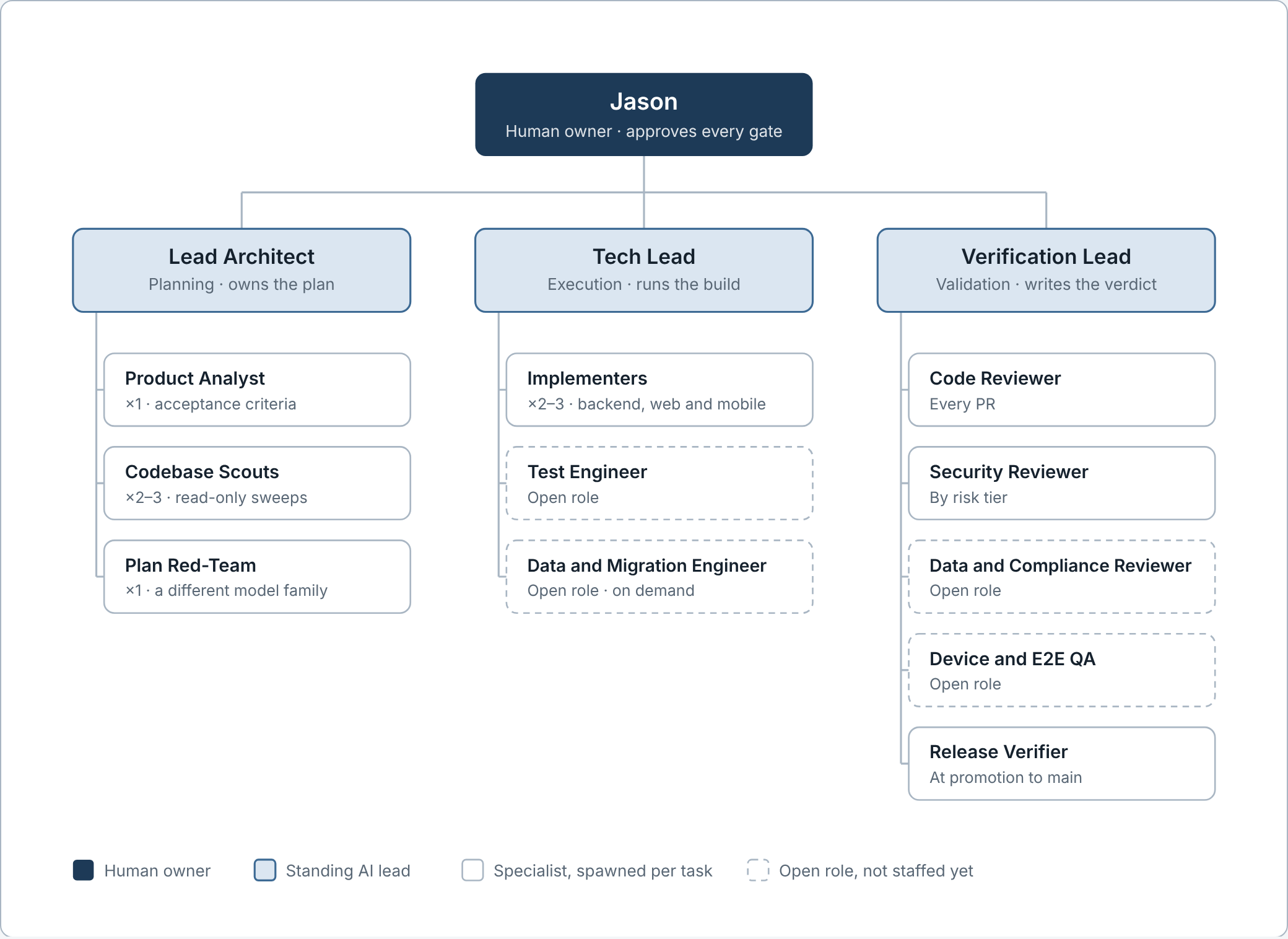
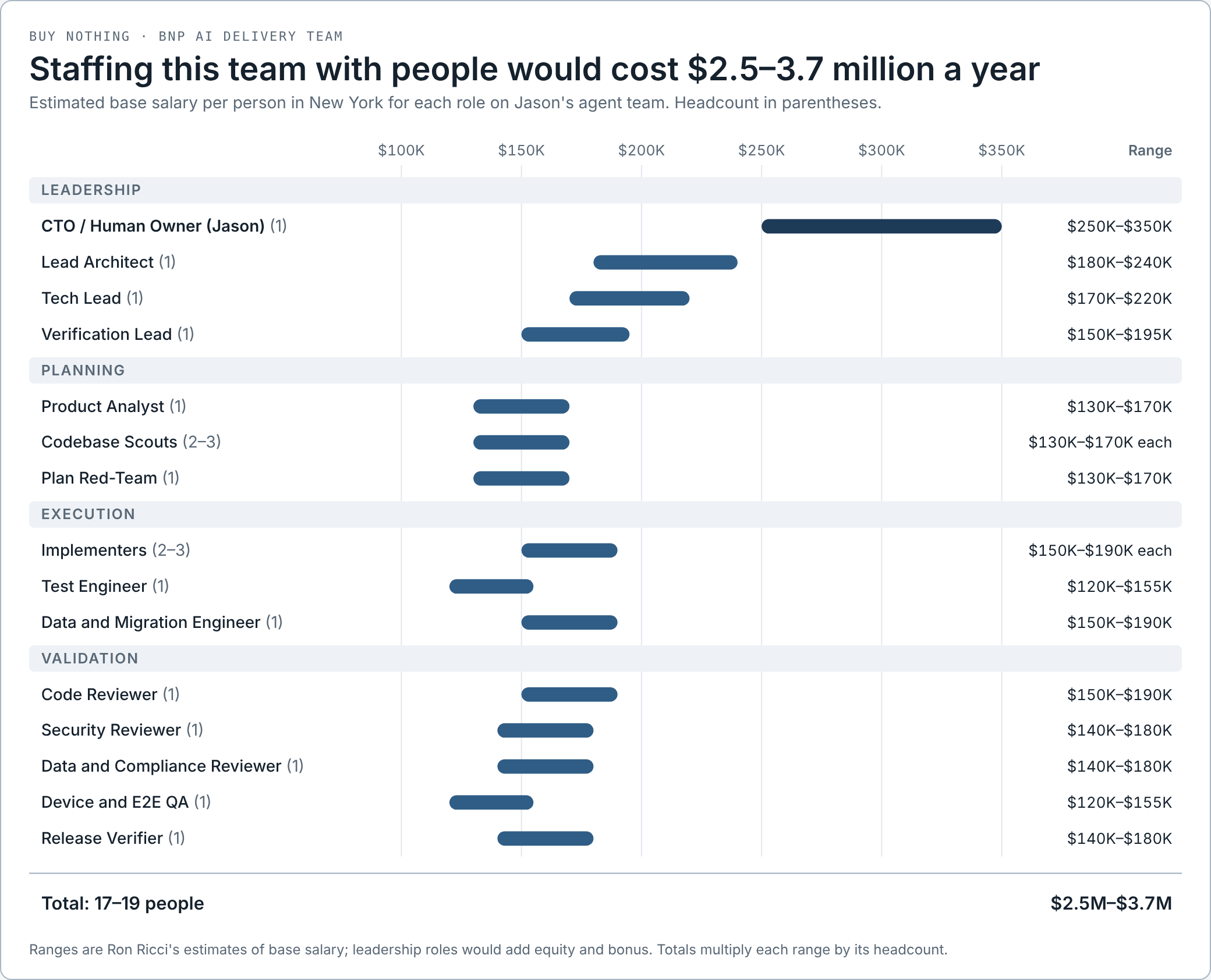
This team of 18 holds positions typically done by humans just a few years ago. I know from my experience that a team of this caliber might take around $3 million in salaries to build in NYC, for example. Jason’s a volunteer at Buy Nothing — so this whole team exists for under $100K/year.
“It’s shocking what you can get done with the right kind of process in mind,” Jason told me.
Even counting a CTO salary, it’s about 85 percent cost savings from an all-human team — or one-eighth the cost.
In reality it’s jaw-dropping productivity — and explains why AI is reimagining work across the world. And why managing today is nothing like it was for boomers, Gen X and millennials.
5 ways managing a team of agents is different from managing humans
1. Spend 80 percent of your time on the plan
Listening to Jason, I’m coming to the conclusion that the planning→execution loop is inverted with agents compared to people. People spend most of their time executing, and lean on their experience or training to understand the concepts of planning — like how to reduce accidents on a shop floor.
Agents simply execute with speed that humans could never match. But taking advantage of that speed requires a lot of planning, according to Jason.
“Of all the time I spend on that problem, I spend about 80 percent of it upfront,” he says. “The other 20 percent, the execution part, actually gets really fast and quick if you really invest the time up front in specifying the plan about what you want your agent to build.”
Most humans would lose their jobs if they only spent 20 percent of their time getting things done.
2. Never let the author grade its own work
Human work tends to get inspected at the end, in an operations review or a weekly commit call.
Jason has a team of agents whose only purpose is to critique code and propose domain-specific improvements (like security) — all the time.
“If I’ve written the code in Claude, for example, I’ll have Codex play a role as a senior system architect. I have a senior security architect role. I have different roles defined that do pull request reviews of code written by another platform to go in and double check it and make sure everything’s tight.”
3. Don’t expect agents to hang out
Teams of humans are working together all day long, on Zoom, in Slack, over email, in text messages. It’s the nature of executing something to have groups of people contributing a piece of the puzzle all the time.
“One thing the AI software hasn’t gotten very good at yet — and I say yet — is they don’t really coordinate amongst each other in terms of tasks in real time,” Jason says. “There’s a bit of memory and runbook going on, but context and an up-to-the-minute perspective is not something it does very well right now.”
Somehow I felt better as a human when Jason said this: “The message bus between agents needs vast improvement before it becomes something akin to teammates working together in real time — there is no equating it to human coworkers because there is no personal or organizational dynamics.”
I had to let that sink in: there is no personal or org dynamics. Literally the exact opposite of work as we’ve known it.
4. Write it down so the whole team remembers
Author (and big thinker) Geoffrey Moore once told me this: “The biggest problem with Cisco is you never write anything down.” It was a completely accurate statement, and the source of a lot of overlapping waste.
Agents on the other hand have no memory or instructions until it’s written down.
“You have to be really disciplined about writing to your runbooks, writing to your memories, making sure that you develop the muscle to prompt to tell it, this is new information in new context,” Jason said.
What was also interesting to me about writing things down is the natural bias toward institutionalizing knowledge — versus people with “institutional” knowledge taking it with them when they leave or move on.
5. Train yourself to see a problem from every angle
So here’s the takeaway for the humans looking to lead an all-agent team: Jason thinks the key skillset to being successful in this role is “being a multi-domain generalist.”
Humans are great at this. “You understand how software is built, but at the same time you understand how marketing works, or how a go-to-market plan works, or how operations works,” he said. “All of those things help you provide the right guidance for the tools to produce the best outcome.”
When I asked Jason how a young person gets there, I wrote down four words in my notes: train yourself to be experienced.
“It’s pattern recognition,” Jason said. “I’ve seen that before.”
How would you train yourself to see patterns of the problems and challenges in a business?
My own reflections: The future of managing
I’m a capitalist. I believe in competition. So part of me is attracted to getting the same output for one-eighth the cost. I know any manager with a team that achieves this kind of productivity gain is going places. I write this newsletter for those kinds of managers.
But: I’ve always managed people with the intention of doing what I can to help them.
This post crystallized for me the coming change we’ve been hearing about for the past two years, and how AI will affect people working today.
And: I’m first and foremost an optimist.
So I know there’s opportunity to be hyper-productive as an AI-assisted organization. It’s clearly happening at Buy Nothing.
But Jason was clear: there needs to be process to make this whole idea work — and humans need to be in the middle of that process, making the judgments necessary.
It’s a great takeaway for the future of managing. “Dot connectors” have always been highly valued in organizations. Piecing together the puzzle is what multi-domain thinkers do — which requires uniquely human skills like curiosity, pattern recognition and, occasionally, unconventional ideas.
How good a manager are you?
Where do you rank on the Six Drivers of Consistency? Take the Self-assessment.
How to be a Great First-Time Manager: The Culture Platform
The only purpose-built mentorship system for first-time managers.
The corporate ladder has been dismantled rung by rung by AI. For millennials and Gen Z, the predictable career path has vaporized — and most managers are navigating it alone, without any formal training.
I’ve managed about 5,000 people in my career, and I was consistently ranked in the top quartile of all managers at Cisco, one of the world’s best places to work. I’ve walked in your shoes as a manager.
I left Cisco to answer one question with research and evidence: what does the manager of the future look like?
My research — conducted with thousands of young people at companies like Amazon, Google, Disney, and DoorDash — identified Six Drivers of Consistency that separate great managers from the rest, at a 95% confidence level.
That research became The Culture Platform: a complete mentorship system — Framework, Feedback, and Tools — purpose-built for first-time managers who want to separate themselves and be a great manager of high-performance teams.
ManagerMentor • All Rights Reserved • The Culture Platform, Inc. • 2026
Managing agents makes the old management basics visible again. One habit that carries over is writing the brief as if the reader has no context, with the goal, the limit on what they may decide alone, and what "done" looks like. If a person could not act on the brief without a follow-up question, an agent probably cannot either, and that is the quickest quality check I know.