

Series: 50 Most Pressing Questions Facing Managers in 2026
It’s easy to say “be authentic.”
My research showed millennials and gen-z want to work for managers who are consistently “true to themselves.”
But what does it really look like?
WHY IS MY AUTHENTIC STYLE SO IMPORTANT?
In the age of AI, people are betting on their manager to help them write a chapter of a career story. They know the corporate ladder is dead. They know all they control is their story. They know change is coming, including opportunities for growth.
So it makes sense that people would want to know how their manager approaches things — how you are inclined to behave when setting goals, making strategy decisions or trade-off choices, and rewarding performance.
Because all of that helps them understand if there truly is an opportunity to grow on your team. The people on your team don’t want to reverse-engineer your brain as their manager. They want you to share the unique way you think, process information, and make decisions.
I’ve found that the best way to be your authentic self is through the lens of your communication style. How you communicate is a reflection of how your brain is wired.
When your people know the way you approach decision-making, they stop guessing and start aligning. They know how to come to you with a problem, how to present an idea, how to tell you when something isn’t working. It’s a virtuous cycle.
In this issue of the Manager Mentor, I’m going to share a model that will help you describe your communication style as a reflection of your thought processes — and make it easy for you to be true to yourself.
WHAT I LEARNED FROM MICHAEL DELL, ERIC SCHMIDT, RICHARD BRANSON AND JOHN CHAMBERS ABOUT COMMUNICATION STYLES.
I was lucky to help some incredible CEOs tell their stories in my career. I was able to work with and watch Michael Dell, Eric Schmidt and John Chambers evolve into world-class communicators — and I was lucky to interview Richard Branson from a stage at a Cisco event in front of thousands of people.
I learned from these experiences that people have two primary questions to answer when assessing their communication style:
How do I process information — am I analytical or am I conceptual?
Am I an introvert or an extrovert?
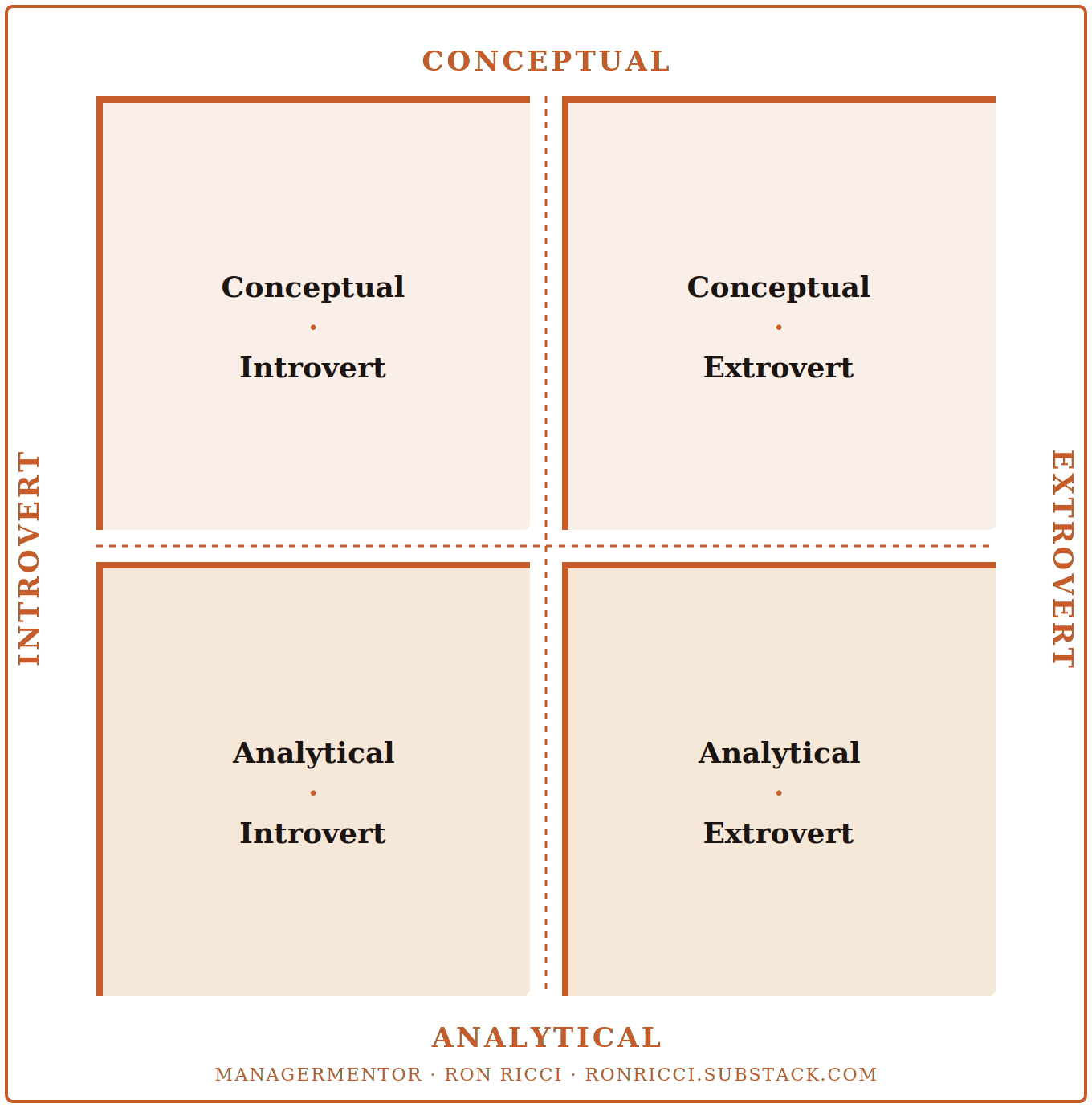
Here’s how I came to think about these four communication styles. Do any of them sound like you?
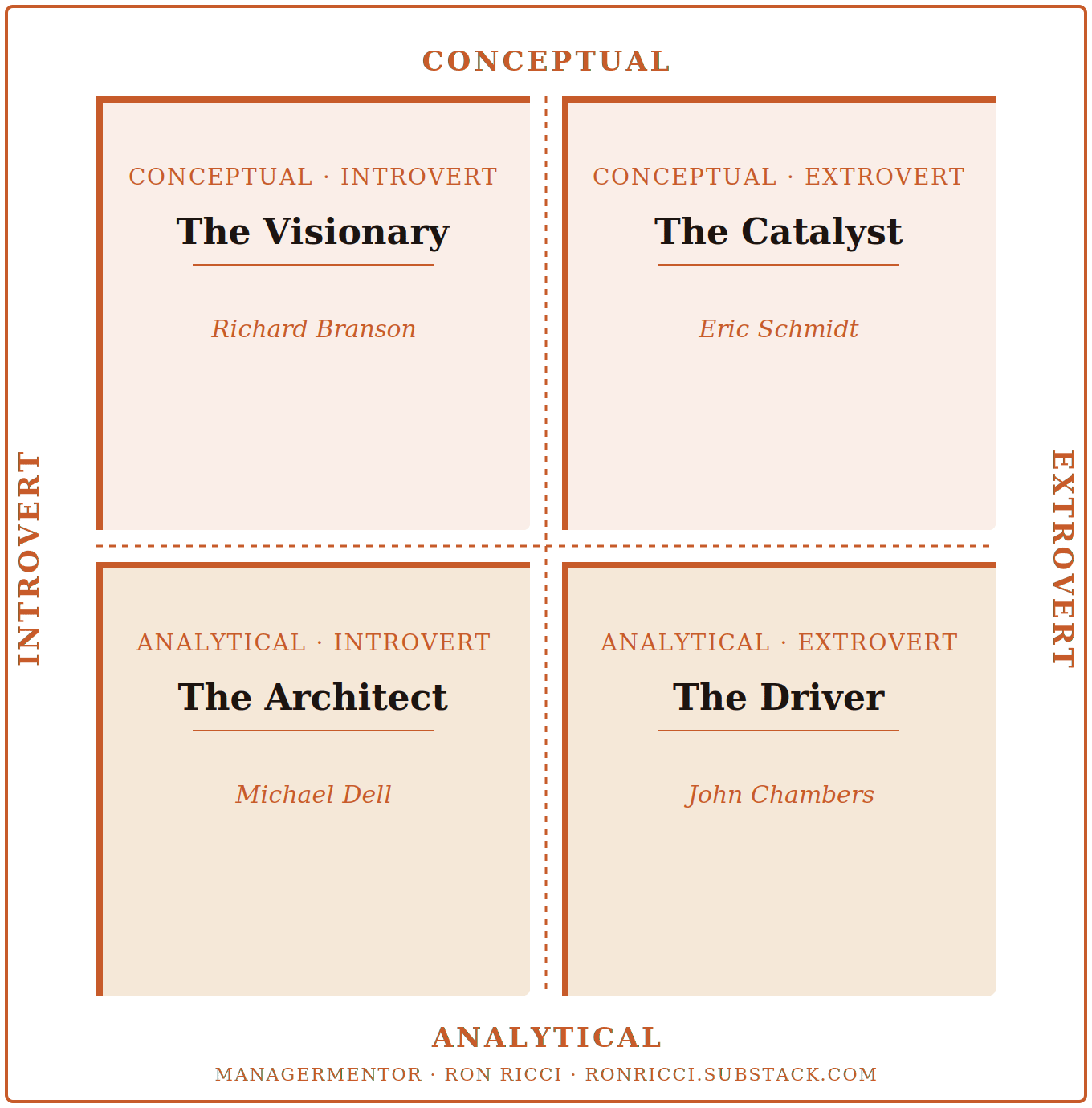
1. Analytical Introvert — The Architect Comfort zone: plans, process, details. Delivery: reserved, factual, specific. Content: methodical, organized, well-prepared.
2. Conceptual Introvert — The Visionary Comfort zone: theories, strategies, concepts. Delivery: calm, detached demeanor that may mask true conviction. Content: full of ideas, shares with discretion, future-focused.
3. Analytical Extrovert — The Driver Comfort zone: results, getting things done. Delivery: confident, quick and forceful. Content: direct, accurate, factual, bias for action.
4. Conceptual Extrovert — The Catalyst Comfort zone: ideas, vision, strategy. Delivery: outgoing, enthusiastic, often spontaneous. Content: big picture, rarely bogged down with detail, uses stories and humor.
I’d need a whole series of newsletters to describe my working experience with these great leaders over the past few decades, but I place them in the following quadrants.
I know many of you may be surprised to see Richard Branson in the introvert quadrant — given his flashy marketing style. But that wasn’t my experience. He was shy, reserved and thoughtful. Think about it: he hot-air-ballooned around the world by himself; he loves his one-person submarine; and he lives on an island.
HOW: Three Steps to Communicate With Authenticity
Step 1: Name Your Style
You can’t share what you haven’t named.
Start with two questions: How do I process information — am I analytical or conceptual? Am I an introvert or an extrovert? Your honest answers are the foundation.
Ask your trusted advisors and mentors these same questions.
In the end, the opposite of authenticity is being someone you’re not. I’ve said this many times to many CEOs over the years: fall in love with yourself — and tell people about it.
Step 2: It Isn’t Personal
Most people don’t wake up in the morning looking to disagree with you. What looks like disagreement is often just a reflection of the way someone else thinks and processes information. An Analytical Introvert and a Conceptual Extrovert can look at the same problem and see completely different things — not because one is wrong, but because their minds work differently.
The best thing you can do is tell the other person how you think and make decisions. When you do that, you give them permission to do the same. And then you’ll each learn something about each other — and know that none of it is personal.
The divide in most teams isn’t about personality conflicts. It’s about communication styles that were never made visible. Once they are, most of the friction disappears.
Step 3: Read Other People’s Cues
Once you know yourself, you can start to recognize others. The easiest way to assess someone’s style is to observe three types of cues:
Communication comfort zone — Do they talk about vision or results? Details or strategies? When do they feel most comfortable in a conversation?
Delivery cues — Are they confident and forceful, or reserved and calm? These are physical cues that show interest.
Content cues — Do they get excited about details or big ideas? Gathering groups or working alone? What tops their agenda and what do they leave out?
Once you’re fluent in identifying styles, you can present information in a way that makes a stronger connection — without abandoning who you are.
SEE WHERE YOU STAND
How consistent are you? Take the Self-assessment.
ManagerMentor • All Rights Reserved • The Culture Platform, Inc. • 2026
This is a GREAT framework and article. I'm a conceptual introvert, all the way.
Loved the descriptions Ron. I’m a Conceptual Extrovert… and work well with the analyticals to ensure I measure results!