

“Don’t be a floater.”
From the point of view of an individual contributor, there’s no worse job than being a “floater” — a role where tangible goals don’t exist and career growth is effectively stalled.
I write this newsletter for managers in this moment in time — the Age of Uncertainty — and how it’s different from managing the boomer generation. Last week I introduced the concept of the “Five Dots of a Career Story” to outline what millennials and gen-z expect from a job role; and how career planning today is completely different from boomers, who had the benefit of the corporate ladder to guide their career progression.
The idea behind the “Five Dots” is to give managers a framework to help individual contributors (ICs) articulate a chapter of a career story in the IC’s current role; the framework is built on the premise a career story is built chapter by chapter with each job role.
There isn’t any rung on any ladder for the next generation of talent to climb.
For the best millennials and gen-z, it’s always a question of whether a job role is worth it: “Can I connect the role to the five dots?” Said another way: “Does this role give me an opportunity to advance?” We boomers need to give millennials and gen-z a break on the way they can quickly change jobs compared to us. In the absence of the corporate ladder, this generation has no other choice than to constantly question the potential of a job role to advance their careers.
That’s why “connecting the dots’ is the foundation to managing this generation; how well you do it as a manager will determine if you have the best people on your team or not. It’s also why millennials and gen-z leave a role — their managers can’t connect the dots for them.
For the next five issues, I’m going to drill into each of the “Five Dots” and share best practices to help managers “connect the dots” between a job role and a career story for ICs working on the team. As I wrote in America’s Manager Crisis, I’m deeply concerned about the lack of manager training taking place in organizations today.
So think of the next five issues as a manager’s training guide for “connecting the dots” — because no individual contributor should ever be a “floater” on your team. For their sake and for your results.
Why: The Five Dots of a Career Story
Think of the “Five Dots” as the ingredients to a recipe. Each dot is necessary and each is a unique ingredient. Like a recipe, this framework is step-by step, dot-by-dot. In the end, conversations about each dot is what it means now to have a career planning dialogue today with anyone in a job role on your team. It’s a co-creation process between a manager and their direct reports.
The Five Dots:
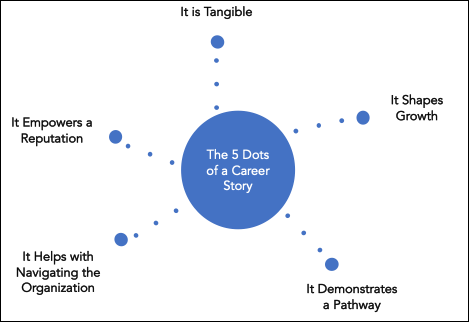
Remember, the point of writing a chapter in a career story around a role is to increase the odds of someone being recognized and rewarded — and, accumulate the organizational and/or market reputation to advance to the next role. That’s what ICs want from their managers today. They know they need to chart their own course.
What: Is My Role Tangible?
For any individual contributor today, alignment is the single most important factor to determine if a job role is tangible. I wish I came up with the concept of a “floater” — someone on a team with an intangible job role — but I heard it from my friend and manager Ces Carter from software innovator Phizzle.
I reached out to Ces because I respect her success as a manager, and I wanted to get a outside-in perspective on making a job role tangible.
“Whether big or small, setting goals always leads to better results,” she started. “But there’s the big gap in organizations. Goals are often set at the company, BU or line-of-business level, but rarely trickle down in specific ways to ICs.”
I love this phrase: “...rarely trickle down in specific ways to ICs.”
“Setting formal expectations for employees is the single most important role of a manager,” she continues. “Otherwise, ICs are ‘floaters.’”
I asked Ces how to avoid becoming a “floater.”
“Today’s managers need to step up more so than in the past to set incredibly clear goals for individual contributors, given all the changes with AI” she concludes. “Every person on the team should be able to hold their box of responsibilities in their hands or risk their relevance.”
Ok, I love phrases, but I also love simple ideas that explain a lot. Here’s question to managers reading this: can everyone on your team hold their “box” of responsibilities in their hands?
What’s in the “Box”?
Ces and I discuss what should be in every IC’s “box” of responsibilities:
A title and, if possible, a title that scales up;
A job description;
A set of job responsibilities;
100% alignment of responsibilities to a goal on a manager’s dashboard;
100% alignment of responsibilities to measures that reflect impact to the goal;
A list of responsibilities that cannot be aligned to a goal or be measured.
Sounds simple enough, but I know in my many years managing, including today, I know I rarely had a complete “boxes” for my people.
As a manager, you want every member of your team executing what matters most to your team’s success. So, of course, the most important action you can take as a manager is to publish your priorities, goals and measure of success. Any job role that does not have direct line of sight to your goals is out of alignment and by definition can’t be “put in a box.”
It can’t be over-stated: goals connect an IC’s career growth to your team’s success.
How: Get Tangible Challenge
I want to challenge leaders and managers to take goal-setting to the next level: ask everyone member of your team to produce their “box” of responsibilities and how it formally aligns with your dashboard, what you are accountable for. See if you can get to 100% alignment.
You’ll see two primary benefits for this exercise.
First, it’s also a once-a-fiscal year opportunity to build a list of execution activities that don’t matter to operational success. You want a list of activities that aren’t aligned to your dashboard — it’s productivity waiting to happen. Your people will love it for taking things off their plate.
Second, the emotional, motivational impact. It has a galvanizing effect on a team, clearly delineating which teammates play what position. It sets people free to be the best of themselves.
It's a win-win. When an individual contributor can hold their box of responsibilities in their hands, their confidence rises, as does their effort. Who doesn’t want a tangible way to know you are part of a team?
How to be a Great First-time Manager: The Culture Platform
Manager Thought of the Week
“Goals aren’t just goals on a slide or chart; they are an IC’s emotional connection to a team.”
Ces told me a lot of great things. I really appreciate this comment, because I know how much emotional commitment means to the productivity of a team. John Chambers told me when we worked together at Cisco that he thought emotion was “worth 1-3 points of growth.” I’m sure for some managers reading this newsletter, connecting the dots seems like a lot of work. It isn’t when compared to the motivation of people are emotionally connected to their jobs. When someone feels validated, it turbocharges their commitment to the work, their belief in what the team is doing and what they are doing on it.
Know a Champion for Manager Excellence?
If your company has a “champion for manager excellence” (like Stefani Okamoto of ServiceNow) ! I’d love to meet and interview them.
In Summary: Principles of Managing in the Age of Uncertainty
I left Cisco to answer this question with research and evidence: What does the manager of the future look like? What are millennials and gen-z seeking in a manager? Which behaviors, tactics, skills or processes matter? What’s it going to take to attract and keep the best people over the next decade? In short, how to be a great manager.
Based on this research, the core philosophy of this newsletter is rooted in one idea: successful managers in this moment in time, for this generation of talent, need to be “career dot-connectors.” The next-gen doesn’t expect to spend their entire career on your team — that’s an idea boomers grew up with. A job on your team is like a chapter in a career story to the current generation. If you want the best people on your team, you have to connect the dots between roles on the team and the career opportunities of the people working on the team.
What is the“Age of Uncertainty”? If the industrial age was about taking predictable steps up the ladder, the age of uncertainty is about finding or discovering the path of a career without any predictable steps, without an obvious ladder — it’s why being a career dot-connector will differentiate you as a manager.
How to be a Great Manager in the Age of Uncertainty: Be a Career Dot Connector is available on Amazon.
What kind of manager are you? Take my free self-assessment and learn about yourself.
My experience with this word floater" was a bit different experience for me personally. ( 1981) Nordstrom Seattle flagship ,still a private CO. I was a " floater". Basically, go where needed. This allowed me to work in all the departments and learn many skills quickly. Also, as I was helping Nordstrom by being flexible and open to growing. I was able to build relationship with many mangers and customers. This knowledge allowed me to pin point where I wanted to put my focus on within Nordstrom. Bonus, inviting in opportunities from current leadership as a potential full time hire position.
A positive outcome for myself and Nordstrom. As I became a leader myself my focus was helping my team grow and level up.