

2025 was just the appetizer; 2026 welcomes the main course. Managing people will never be the same.
The tone of this newsletter changed dramatically around April of last year. It was clear, obvious and concerning to see the impact of AI on career-pathing, especially for anyone under 25 and anyone over 50 years old.
We saw in 2025 a clear slowdown in jobs focused on traditional roles, not necessarily because AI was replacing them, but because companies knew they had to sort out what an AI-centered workforce looks like. There’s no way it takes longer than 2026 to complete first phase of AI-centric organizations.
For managers of people, it’s like the past didn’t exist.
My research into the future of managing found that millennials and gen-z want to work for managers who are consistent — especially as the ground keeps shifting beneath them. The next generation of talent knows all they can control is their story. They are well past the idea that a corporate ladder as a “given” like their parents.
In short, millennials and gen-z want to work for a manager who “gets this” and will help them write a chapter of a career story — to help them grow and advance into the next role, not next rung on the ladder. The best talent know they need to write “bestsellers” about themselves in any role — or it’s not worth it.
Which changes everything about managing people.
What happened in 2025 was indeed like an appetizer: it was a tease of AI’s true impact on the workplace. This next year will reveal specific frameworks/models/philosophies that drive an organization’s operating model for the next 3-5 years. In short, where companies place their bets with leadership, budget and headcount, and where they don’t.
All of this will land in the laps of managers — the people responsible for executing what an AI-centric workforce looks like. No matter what the changes look like, the most successful will those managers who are consistent in how they approach the change; for two reasons:
Systematic change at ever-increasing speeds and cycles can’t be navigated with a shotgun, spray-and-pray approach. Disciplined, authentic behaviors will. Knowing where you are consistent and inconsistent as a manager is the key to being a great manager.
The next generation of talent doesn’t want to work with inconsistent managers. That was ok in the boomer generation when the corporate ladder stood behind every manager. The best people will gravitate to managers who consistently help them “connect the dots” to a bestselling career story through the work they do together.
Skills tell your story better than any job title.
How do managers adapt? How do you connect the dots? How do you get the best people?
Start with this mindset entering 2026: in “search” terms, more people will focus on “career skills” than “career ladder” for the first time.
The ladder was something to grab onto with your hands as an employee to steady your career path. “Skills” are the way millennials and gen-z will find a career path and tell a story about themselves that is ideal for the career path.
In 2026, operationally, job titles and job descriptions will be replaced by “skills-based roles.” Skills will show what someone is capable of achieving. Skills-based roles will come and go as AI evolves.
I think there are three types of skills:
Human Skills: Skills that showcase your strengths and why you matter. Such as: emotional intelligence or creative problem-solving.
Technical Skills: Skills that demonstrate what you can do. Such as financial modeling or CRM.
Adaptive Skills: Skills that show you can evolve with change. Such as: “comfort with ambiguity” or “systems thinking.”
I’ll be writing about the revolution to a skills-based culture over the month of January.
To kick off the new year, I built this framework with 30 examples of “skills” — 10 for each of the three primary skills — to help managers educate themselves on what skills actually look like in the real world:
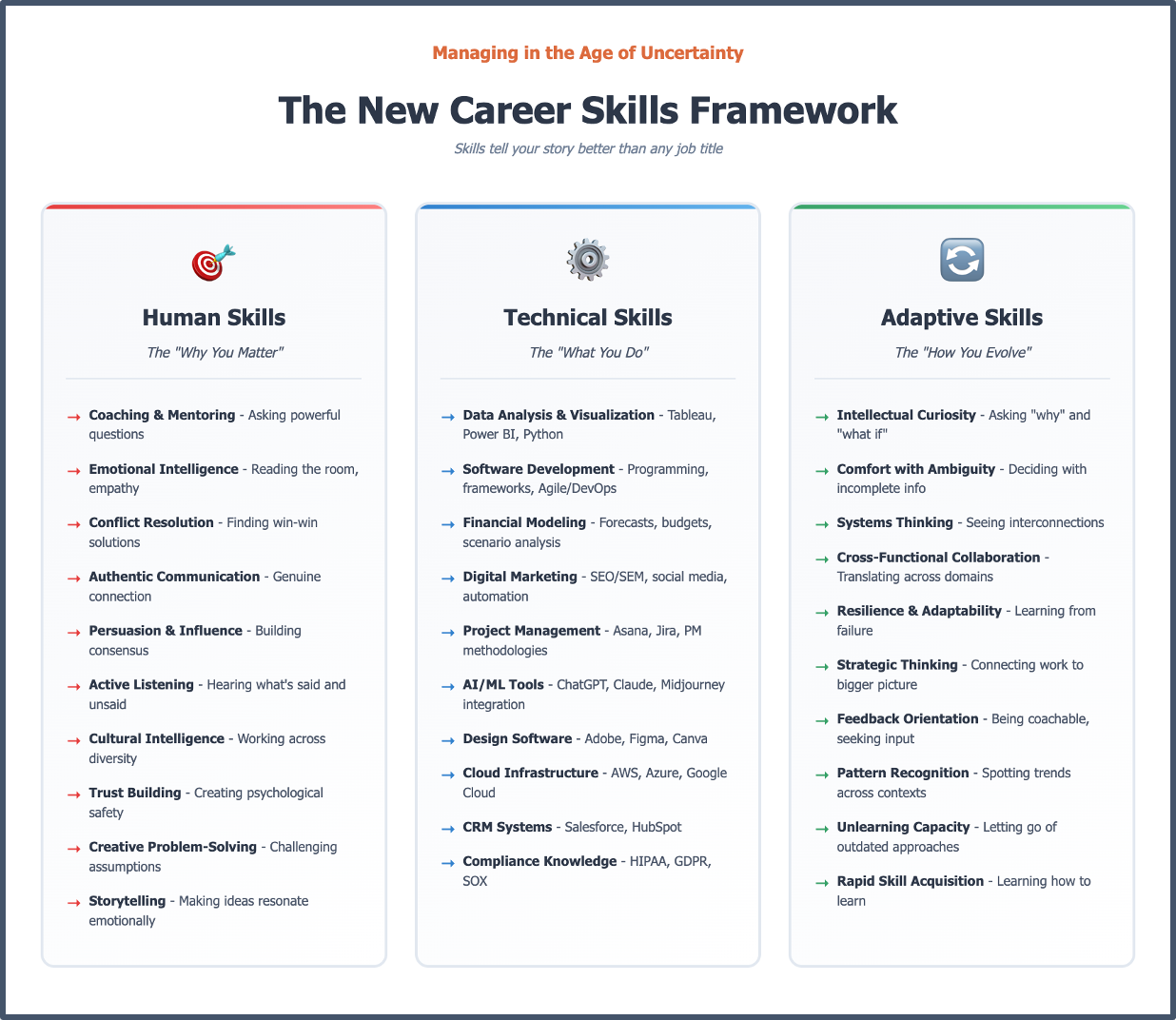
Manager Homework: Get Ready to Reframe Career Conversations
For managers, it might be time to stop talking about the “the next role” in career conversations with your people and to start mapping skill development pathways.
Take these three steps before your next career conversation:
Share the “Career Skills Framework” with everyone on your team.
Ask everyone to pick their top two skills in each category.
Ask everyone to be prepared for this conversation:
Employee asks: “What’s my career path here?”
Corporate ladder answer: “You’re a Marketing Coordinator now. In 18 months you could be promoted to Marketing Manager if a spot opens up.”
Skills pathway answer: “You’re building three key capabilities right now:”
Campaign strategy (you’re learning this on the Q4 launch)
Cross-functional leadership (you’re developing this by running our agency relationships)
Data storytelling (we’ll build this next quarter when you own our metrics reporting)
It’s big change — for everyone. It’s harder to “connect the dots” than it was to “climb the ladder.” But it’s also exciting, a chance to invent the future. I look forward to talking about it with you over 2026!.
Try Career Story Builder
Recently I launched an AI-powered tool called “Career Story Builder” to provide a mentor, coach and buddy to help people write best-sellers about themselves — and why they’re ready for the next skills-based role.
Give the Career Story Builder a try. It’s free and unlimited. I’d also love to hear your feedback about how to make it better. It’s new and I’m sure it can be improved. Send me a DM with any thoughts.
In Summary: Principles of Managing in the Age of Uncertainty
I left Cisco to answer this question with research and evidence: What does the manager of the future look like? What are millennials and gen-z seeking in a manager? Which behaviors, tactics, skills or processes matter? What’s it going to take to attract and keep the best people over the next decade? In short, how to be a great manager.
Based on this research, the core philosophy of this newsletter is rooted in one idea: successful managers in this moment in time, for this generation of talent, need to be “career dot-connectors.” The next-gen doesn’t expect to spend their entire career on your team — that’s an idea boomers grew up with. A job on your team is like a chapter in a career story to the current generation. If you want the best people on your team, you have to connect the dots between roles on the team and the career opportunities of the people working on the team.
What is the“Age of Uncertainty”? If the industrial age was about taking predictable steps up the ladder, the age of uncertainty is about finding or discovering the path of a career without any predictable steps, without an obvious ladder — it’s why being a career dot-connector will differentiate you as a manager.
How to be a Great Manager in the Age of Uncertainty: Be a Career Dot Connector is available on Amazon.
What kind of manager are you? Take my free self-assessment and learn about yourself.
Insightful. Lots to ponder. "Unlearning capacity"... first time I've heard this phrase.
This skills framework seems spot on, Ron. I think AI could also be viewed as an enabler of all skills ... as a resource for researching/learning and even practicing them to a certain degree. But reaching proficiency and mastery is ultimately in our human hands.