

I couldn’t believe Cisco’s senior management didn’t have a common understanding of what “strategy” meant.
As Cisco CEO John Chambers navigated the end of the dot-com era, he adopted communication as a way to get the company on the same page and create a culture ready to adapt to the new reality. It played to his strengths as a generational communicator, and it played to mine.
Except we kept kept getting the same feedback from employees: they didn’t understand Cisco’s strategy and what we were trying to communicate. So I called a meeting of John’s direct reports to see how we could improve what we were saying about our strategy.
If there were five people in the meeting, there were five different definitions of what “strategy” meant. It dawned at me in the moment: if we couldn’t speak the same language, how could we successfully communicate our strategy?
Strategy, at its heart, is about making choices. It’s not some big, complicated intellectual idea. It’s about being clear about your priorities — so the team can align their work to what’s important and stop doing things that aren’t.
It’s exactly this issue of alignment that makes a common operational language fundamental to managing people — especially in the age of AI. Boomers could occasionally be “out of alignment” because the corporate ladder provided the foundation to right someone’s career path over many years.
On the other hand, my research into the future of managing showed that millennials and gen-z want to work for managers who consistently align job roles to priorities, goals and metrics.
The next gen knows the key to growth and advancement starts and ends with alignment — millennials and gen-z understand they can’t count on the corporate ladder. That’s why they are constantly evaluating whether their current role advances their story and career opportunities — and a lack of alignment is an early indicator of the potential of a job role create growth (or not).
Today’s newsletter is the second in a five-part series to provide a consistent framework for managers to drive alignment. Here are the five parts:
Last week: The Manager Dashboard— Job Role Alignment Framework
Today: Why a common vocabulary is the secret ingredient to alignment
Next week: How shared goals set the context for a “box” of responsibilities
Metrics: There can only be one scorecard of success
Alignment examples: Writing a chapter of a career story
Why a Common Operational Language?
Ambiguity is the enemy of alignment.
The idea behind a common vocabulary is to eliminate ambiguity or possible gray-zones in communicating what you are accountable for as a manager — your priorities, goals and metrics of success.
Ambiguity makes job role alignment almost impossible; it confuses job responsibilities with different priorities and renders measurement useless.
And let’s not forget: chances are you have some people on your team who have never worked together before – speaking the same operational language can improve time to alignment and execution. It actually accelerates team performance. No more 30-minute discussions about whether something is a "project" versus an "initiative."
When everyone knows the operational language, the team can focus on execution instead of translation. Alignment is the goal, but execution performance is the outcome. You want your people spending their time getting things done.
What Operational Languages?
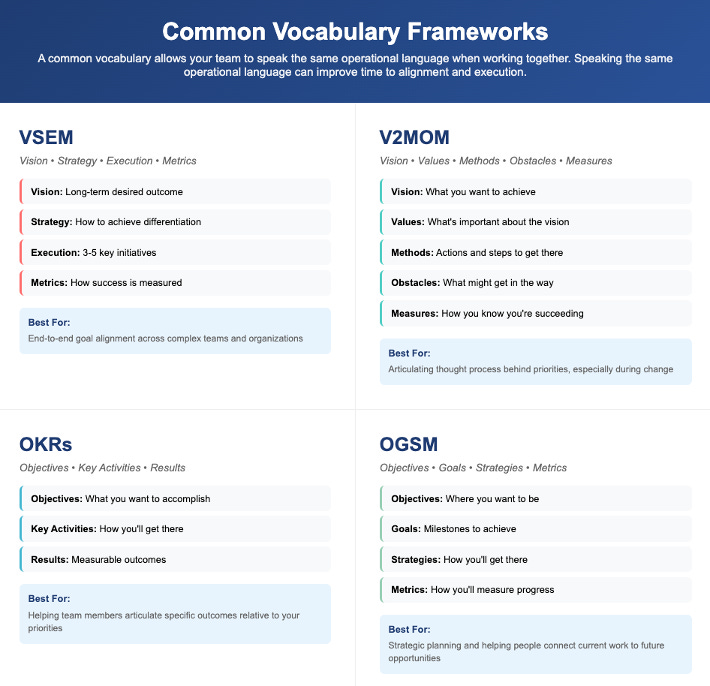
I don’t have a position on which operational language to use on your team — except to say you need one. I’ve documented four in this week’s newsletter so you can learn about them and choose one that works for you. Each of the choices has strengths, especially for specific team needs. As you think about your team, consider what each language is “best for” you.
VSEM (Vision-Strategy-Execution-Metrics) Developed at Cisco, VSEM is a linear framework that moves from long-term vision to measurable results. Vision defines the desired future state, Strategy outlines how to achieve differentiation, Execution breaks down into 3-5 key initiatives, and Metrics track progress. Best for complex organizations needing end-to-end alignment.
V2MOM (Vision-Values-Methods-Obstacles-Measures) Developed by Salesforce, this framework emphasizes the thinking process behind decisions. It includes what you want (Vision), what's important about it (Values), how you'll get there (Methods), what might block you (Obstacles), and how you'll know you're succeeding (Measures). Best when priorities are changing and you need to explain your reasoning.
OKRs (Objectives-Key Results) A goal-setting system popularized by Google. Objectives are qualitative goals, Key Results are measurable outcomes that indicate progress toward the objective. Typically set quarterly with 3-5 objectives and 3-5 key results each. Best for helping individuals articulate specific outcomes relative to broader priorities.
OGSM (Objectives-Goals-Strategies-Metrics) Used by companies like P&G, this framework separates long-term objectives from shorter-term goals, then defines strategies to achieve them and metrics to measure progress. The distinction between objectives and goals provides clarity on different time horizons. Best for strategic planning and connecting current work to future opportunities.
You can download templates for these languages here:

How an Operational Language Drives Alignment
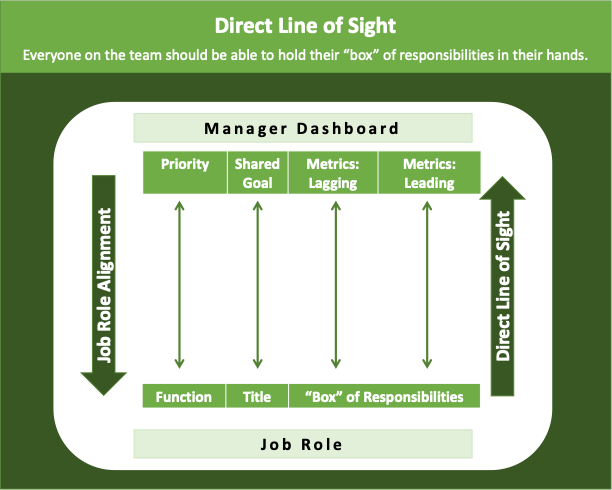
Every member of your team needs to have what I call direct line of sight from their job role to their manager’s priorities, goals and metrics. People on your team should be able to hold their “box’ of responsibilities in their hands and know how the “box” shows up on your dashboard.
Last week I published the “Job Role-Manager Dashboard Framework. In this framework, a common operational language is what informs the priorities, goals and metrics — consistently.
Your Homework Assignment
Think about yourself and how you manage your team. Do you consistently speak the same language on your team? Does your team have challenges separating what’s important from what’s urgent? Does everyone have too many things to do? Your operational language can pinpoint everyone to the highest order of impact — exactly what your people and you want.
Manager Thought of the Week
"Strategy is a series of actions designed to accomplish the goal of differentiation."
Cisco adopted a common operational language called Vision-Strategy-Execution-Metrics (VSEM). It remains one of the signature contributions my team made to Cisco’s ongoing success. John Chambers really wanted to demystify strategy and focus on getting things done. Over the 10+ years John used VSEM to set annual priorities, goals and metrics, Cisco’s revenue went from $18.9 billion in 2002 to $49 billion in 2015.
In Summary: Principles of Managing in the Age of Uncertainty
I left Cisco to answer this question with research and evidence: What does the manager of the future look like? What are millennials and gen-z seeking in a manager? Which behaviors, tactics, skills or processes matter? What’s it going to take to attract and keep the best people over the next decade? In short, how to be a great manager.
Based on this research, the core philosophy of this newsletter is rooted in one idea: successful managers in this moment in time, for this generation of talent, need to be “career dot-connectors.” The next-gen doesn’t expect to spend their entire career on your team — that’s an idea boomers grew up with. A job on your team is like a chapter in a career story to the current generation. If you want the best people on your team, you have to connect the dots between roles on the team and the career opportunities of the people working on the team.
What is the“Age of Uncertainty”? If the industrial age was about taking predictable steps up the ladder, the age of uncertainty is about finding or discovering the path of a career without any predictable steps, without an obvious ladder — it’s why being a career dot-connector will differentiate you as a manager.
How to be a Great Manager in the Age of Uncertainty: Be a Career Dot Connector is available on Amazon.
What kind of manager are you? Take my free self-assessment and learn about yourself.
Great read. This is hyper-relative as many legacy brands are in the middle of digital transformation and struggling to communicate effectively. Loved this line: “ambiguity is the enemy of alignment”