

The best people always write their own stories.
Writing a career best-seller is the new way to think about career planning.
In the boomer generation, people didn’t need to write their own stories. Instead, the corporate ladder provided the plot, the characters, the drama and the outcomes.
I write this newsletter to share what I’ve learned about the future of managing from my research and experience. I named it Managing in the Age of Uncertainty to reflect the differences between managing millennials and gen-z from boomers.
Nothing is more representative of the generational differences than career planning (boomers) and career as a story (millennials and gen-z).
The number one reason someone leaves a job today is a lack of career growth or advancement — reflecting the end of the corporate ladder. The best of millennials and gen-z don’t expect to work in one place for their careers anymore. They have a personal vision for themselves and know their career path will be like chapters in a book.
The best people actively look to write the next chapter of their career story; they are charting their own course. Which means the best people on your team are wondering — as you read this — if they should spend their next chapter on your team or another team.
In this issue of my newsletter, I’m focusing on how managers can help people on their team align their role to a chapter of a career story — and bring out the very best of your people. As a manager, you want your people excited to execute what’s on your dashboard, what you are accountable for — because having people with a chapter of their career story on your team is like having a team of best-selling authors working for you.
What is Career as a Story?
Let’s start by breaking down the basic motivations we know about millennials and gen-z: on one hand, they want to know their current job role leads to growth. On the other hand, they want to know growth leads to advancement.
As a manager, you sit at the intersection of these motivations; it is your job to help people connect the dots on opportunities on your team to a person’s career story. Being a great “career dot connector” is what will attract the best people and build the best team — and what I believe will separate great managers with high performing teams from good managers with average performing teams.
A career story requires stitching together many factors that reflect both today’s unpredictable workplace and the uniqueness of everyone as an individual. To that end, I’ve built a model called the “Five Dots of a Career Story” to provide a consistent framework. It’s your job as team manager to help your people connect these five dots to the job roles on your team.
Each person has a job role on your team; and, each person is also a unique talent, with a particular set of strengths and weaknesses. Alignment to a job role is only one half of a career story; the other half is grounded in what someone brings to the table, their strengths as a person. In this context, everyone individual, in every role, on your team should be able to clearly answer these five questions — the Five Dots of a Career Story:
Is my role tangible?
Can I align 100% of my job responsibilities to the priorities my manager is accountable for? If my job role is not on your dashboard as a manager, I don’t have a career chapter on the team.
Does my role shape growth?
Am I in a job role that plays to my strengths — and do I agree with I am playing to my strengths? People can’t be great at everything. It’s your job as manager to ensure people know what makes them a special talent and what doesn’t.
Does my role demonstrates a pathway?
Can I envision how a job role on this team can lead to a potential future role — either on this team or outside this team? Scaling up a job role is one way to help your people see a future pathway. If you can’t scale up the role, then maybe your team isn’t the place for someone, but it might be on another team where scaling up is possible.
How does this role navigate the organization?
How does this job role empower me to“show up” in the organization — so I don’t need to deal with unproductive politics? It’s up to you as a manager to make sure every job role aligns to work you are accountable for. Your people need this alignment because it sets them free to represent you in the organization when you aren’t in the room. It enables your people to focus on execution, not positioning.
How does this role empowers a reputation?
What impact am I having on my manager’s priorities — could this be a signature opportunity at this stage of my career? Not every role has an opportunity to turbocharge a career. But some roles do. Your very best people crave accountability and the recognition that comes with success that shines on your dashboard. Give it to them.
People are proud and want to tell career stories, and why they love their jobs. When someone can see the path to accountability in a job role that plays to their strengths, it gives them the confidence they will get recognized — and advance the next opportunity — or next chapter, that is — in their career story. Those people will never forget you as their manager and what you did for them.
How to Be a “Great Career Dot Connector”
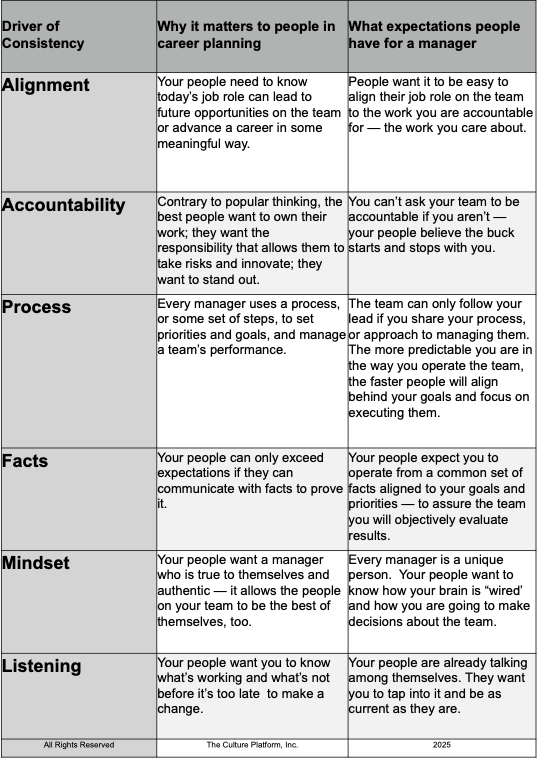
Consistency is the key to being a great career dot-connector. In my research into the future of managing, I identified Six Drivers of Consistency that are the necessary building blocks to make it possible for people to “connect the dots” to their career stories.
Consistently being clear about your priorities, your goals and how you measure success is the foundation to aligning a job role to someone’s career opportunities.
As a reminder, here is a snapshot of the Six Drivers:
Do you know your strengths and weaknesses as a manager? How consistent you are? Start by self-assessing yourself here for free:
The best people have great expectations for themselves. They want to get ahead. They are motivated to put the work in. Some are likely aiming for your job, or already think they can do it better than you. It’s human nature to move forward. It’s your job to help them tell their story. They will love you for it.
How to be a Great First-time Manager: The Culture Platform
Manager Thought of the Week
“Five players are like fingers on a hand; together they form a fist.”
John Chambers and I once hosted Duke basketball coach Mike Krzyzewski at a Cisco leadership meeting. “Coach K” used these words to explain success in basketball to Cisco’s leadership. The same is true for the five dots and your people. When you can connect the dots, people will be energized to be part of the team because they feel the confidence of their “career fist”.
Know a Champion for Manager Excellence?
If your company has a “champion for manager excellence” (like Stefani Okamoto of ServiceNow) ! I’d love to meet and interview them.
In Summary: Principles of Managing in the Age of Uncertainty
I left Cisco to answer this question with research and evidence: What does the manager of the future look like? What are millennials and gen-z seeking in a manager? Which behaviors, tactics, skills or processes matter? What’s it going to take to attract and keep the best people over the next decade? In short, how to be a great manager.
Based on this research, the core philosophy of this newsletter is rooted in one idea: successful managers in this moment in time, for this generation of talent, need to be “career dot-connectors.” The next-gen doesn’t expect to spend their entire career on your team — that’s an idea boomers grew up with. A job on your team is like a chapter in a career story to the current generation. If you want the best people on your team, you have to connect the dots between roles on the team and the career opportunities of the people working on the team.
What is the“Age of Uncertainty”? If the industrial age was about taking predictable steps up the ladder, the age of uncertainty is about finding or discovering the path of a career without any predictable steps, without an obvious ladder — it’s why being a career dot-connector will differentiate you as a manager.
How to be a Great Manager in the Age of Uncertainty: Be a Career Dot Connector is available on Amazon.
What kind of manager are you? Take my free self-assessment and learn about yourself.
Excellent post Ron. I love the idea of career as a story.