

5 Tips for mentors in the Age of AI.
My first five years at Cisco were undeniably the most impactful and everlasting.
The core of my team’s work was focused on how communications could drive a culture of adaptability at the company — to quickly get people on the same page about what the company needed to do to stay on top. Many of the artifacts of this communication process are still present in the company today.
This work resulted in the invention of a new function inside Cisco, and later across the broader technology industry, called executive communication. I was lucky to assemble a team of incredibly talented individuals to pioneer what became known as "excom.” This team included amazing people like Maureen "Mo" Kasper, Jackie Landsman, Dora Ferrell, Eileen Goodwin, Lisa Giblin, Mary Gorges, Julianne Whitelaw, Karen Hodskins, among many others, and an emerging leader named Erin Bergamo Tacy.
If a communications hall of fame existed, Erin would be in it for her work at Cisco, Vmware, Lenovo, AWS and Couchbase — organizations where she’s lead communications and marketing teams over the past 25 years. Erin’s also a member of the UC, Santa Barbara Communications Alumni Council, focusing on partnerships and mentoring.
Most importantly to this issue of Managing in the Age of Uncertainty, her story is really one of helping people — through mentoring and coaching. Last week, I interviewed Rene Siegel to hear the latest on mentoring recent college grads. This week, I’m sharing what I learned from Erin about mentoring career professionals. My goal was to learn what’s top-of-mind right now, given the dynamics of AI’s impact on career-pathing for millennials and gen-z.
Here is my key takeaway: We need to redefine what we mean by mentoring for this moment in time for working professionals. If the boomer concept of the career ladder is dead or dying, mentors need to teach new skills to mentees— to increase the odds of people telling better stories about themselves and standing out.
Why Mentor?
“Many of the companies I’ve worked at were growing so fast that it was often easier to throw headcount at the growth instead of training and development,” Erin tells me. “I’m an operational, global leader, and I knew retention would be a problem.” Which is why she’s so invested in mentoring and coaching people. She’s really humble: “I’m not sure I’m an expert, but I help people if they contact me and I guess I have a lot contacts.”
After the interview with Erin I synthesized her thoughts into “Five Tips” for mentors working with career professionals. I wanted to be top-of-mind to today’s realities, and I want to thank Erin on behalf of readers of this newsletter. While these are intended to help mentors, I think these five tips are valuable to managers as well.
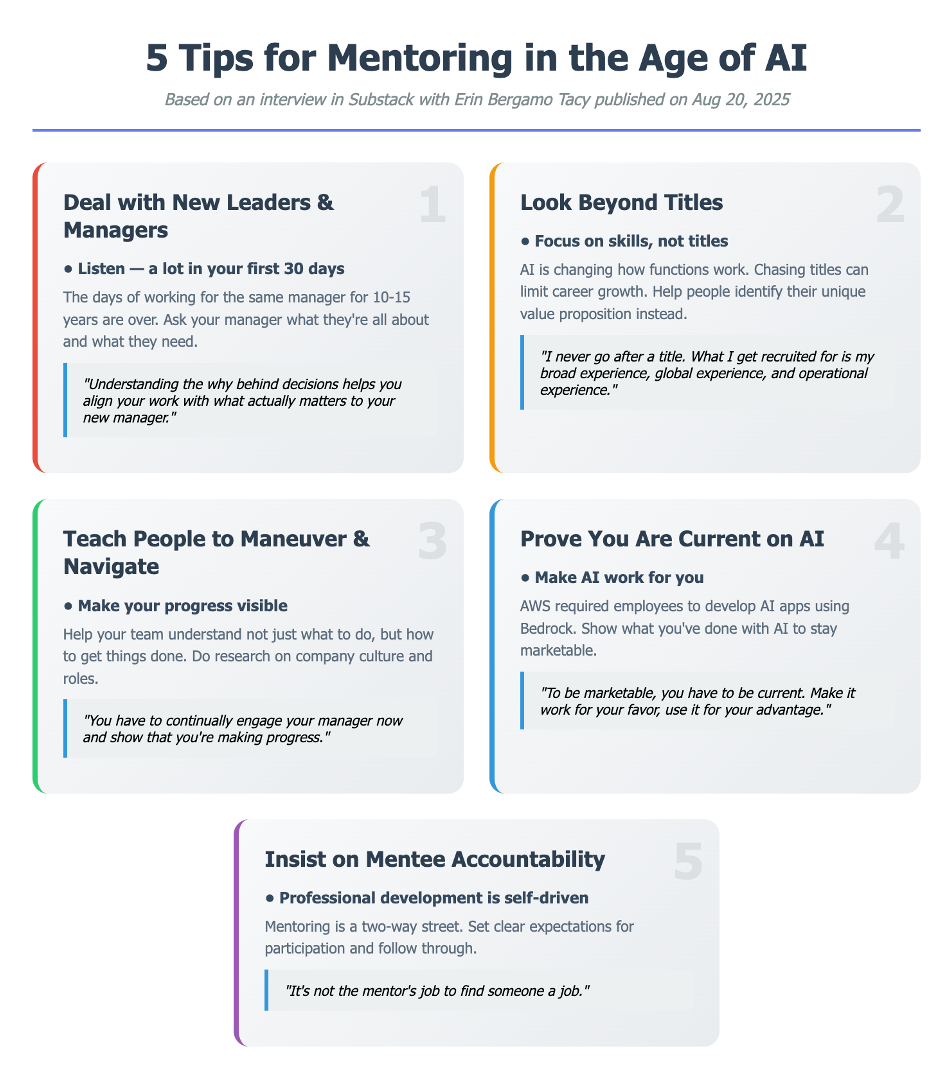
1. Learn How to Deal with New Leaders and Managers
The pace of change in today's workplace means you'll constantly encounter new leaders and managers. The days of working for the same manager for 10-15 years are over. Erin’s recommendation: “Try to quickly understand what motivates your new boss.”
Key Strategy: Listen — a lot. "I talked to 30 leaders across the organization in my first 30 days at Couchbase,” she tells me. “You can do the same with your new manager. Ask the manager to tell you what they are all about, what they need. Try to get your manager to lay it all out on the table.”
Decode The True Priorities New managers always have a set of priorities. As Erin learned: "Understanding the why behind decisions helps you align your work with what actually matters to your new manager.”
2. Encourage People to Look Beyond Titles
Because we all know AI is changing how each function in a company works, chasing a title can actually limit career growth. Erin suggests mentors help people identify and leverage their unique value proposition instead.
Focus on Skills, Not Titles "I never go after a title. What I get recruited for is my broad experience in communications, my global experience, and my operational experience. Those are the three things that I know I'm good at."
Help People Discover Their Strengths "A lot of mentoring today is about helping people figure out what you’re good at. Sometimes people are still caught up in title chasing, as opposed to 'this is what I'm good at and this is a job where I can succeed because it's going to leverage my skills.'"
3. Teach People How to Maneuver and Navigate
I really appreciate the nuance of this suggestion. With things changing so fast, navigating an organization — maneuvering — is more critical than ever. Your role as a mentor or manager includes helping your team understand not just what to do, but how to get things done.
Make Your Progress Visible One of the best ways to navigate an organization is to stay constantly visible. "You have to continually engage your manager now and show that you’re making progress.”
Do Research Know what kind of company culture you want to work in — because navigating the culture may not play to your strengths. "You have to do research. You're gonna have to put the effort in on the type of company you want to work for, the type of role you're interested in.”
4. Prove Your are Current on AI
I learned from Erin that AWS marketing required every employee to develop some kind of AI app using the AWS Bedrock platform and show you are using the app. This is the new job reality. So I guess this tip applies to both mentors and mentees.
Make AI work for You “To be marketable, you have to be current,” Erin says. “Make it work for your favor, use it for your advantage.” I really believe in this idea of “building in public” when it comes to AI, and now I know it’s a job requirement at companies like AWS. The best way to show you are current on AI is to show what you have done with it.
5. Insist on Mentee Accountability
I heard this from Rene as well. Mentoring is a two-way street. Younger people, in particular, need to recognize that follow through is an enduring differentiator.
Set Clear Expectations In mentoring relationships: "The mentee has to fully participate. They need to make good use of the mentor's time, schedule things and follow up."
Professional Development is Self-Driven “I’m not here to find you a job,” Erin tells me. She shares what she learned from Karen Hodskins: "Your professional development is not my responsibility. It's your responsibility." Mentors should keep the role clear.
Manager Thought of the Week
“You can sit at the big table.”
I was lucky to meet Andy Cunningham early in my career and worked with her for 11 years — eventually becoming her business partner. She was a great mentor for me at an important juncture in my career: right when I was ready to grow into a leader, she told me about sitting at the big table. Andy sat at the big table with Steve Jobs and it was at her insistence that I do whatever it took to sit at the big table with John Chambers at Cisco, which ultimately lead me to 10+ years in the C-suite at Cisco. Belief is part of what matters to get ahead. I’m grateful to Andy for helping me believe in myself.
In Summary: Principles of Managing in the Age of Uncertainty
I left Cisco to answer this question with research and evidence: What does the manager of the future look like? What are millennials and gen-z seeking in a manager? Which behaviors, tactics, skills or processes matter? What’s it going to take to attract and keep the best people over the next decade? In short, how to be a great manager.
Based on this research, the core philosophy of this newsletter is rooted in one idea: successful managers in this moment in time, for this generation of talent, need to be “career dot-connectors.” The next-gen doesn’t expect to spend their entire career on your team — that’s an idea boomers grew up with. A job on your team is like a chapter in a career story to the current generation. If you want the best people on your team, you have to connect the dots between roles on the team and the career opportunities of the people working on the team.
What is the“Age of Uncertainty”? If the industrial age was about taking predictable steps up the ladder, the age of uncertainty is about finding or discovering the path of a career without any predictable steps, without an obvious ladder — it’s why being a career dot-connector will differentiate you as a manager.
How to be a Great Manager in the Age of Uncertainty: Be a Career Dot Connector is available on Amazon.
What kind of manager are you? Take my free self-assessment and learn about yourself.