

Are you saving money or making money?
In the end, only these two metrics matter today.
The lens of success in the age of AI centers around productivity/efficiency and the top-line. Feel-good metrics like brand awareness or influenced revenue are things of the past.
I write this newsletter for managers and how they can thrive, despite a span of control that is twice that of boomer managers — and the expectation that AI will change everything about the way the team functions. The margin of error is slim to succeed.
That’s why I’ve said many times that managers are the most-needed and most-underrated stars of any organization.
What great managers do today is a maniacal focus on alignment. The most effective teams have 100 percent alignment between every job role and the manager’s priorities, goals and metrics. In short, great managers ensure there is no margin of error on their teams or any waste in the system.
Today’s newsletter is the fourth in a five-part series to provide a consistent framework for managers to drive alignment. Keep in mind, my research showed millennials and gen-z want to work for managers who are consistent — especially with job role alignment. Here are the five parts to consistently drive end-to-end alignment on teams:
Why a common vocabulary is the secret ingredient to alignment
How shared goals set the context for a “box” of responsibilities
Today: Metrics are the glue of alignment
Alignment examples: Writing a chapter of a career story
Why there can only be one scorecard of success
Metrics are the glue that brings a team together around what success looks like — for managers and teammates alike. As the binding agent of execution, metrics can’t be open for interpretation. A common set of facts is the essential for metrics to work as the “team glue.”
As a manager, a common set of facts accomplishes three goals:
First, your goals and how they are measured set the context for every job role on the team – it will be the most productive act you take every planning cycle.
Second, your best people want to own their work – facts link a job role and a goal you care about. Exactly what people want and what motivates them.
Third, how you handle performance management will be simpler. Your metrics are the single source of truth.
Members of the team also benefit from consistent metrics: they make it possible to show how a job role drives impact. Any great career story is a combination of someone’s strengths and their accomplishments.
What to Do: Start with a common vocabulary model
If the goal is 100 percent alignment, it has to be easy for members of the team to see how their “box” of responsibilities aligns to the work on your dashboard and what you’re accountable for.
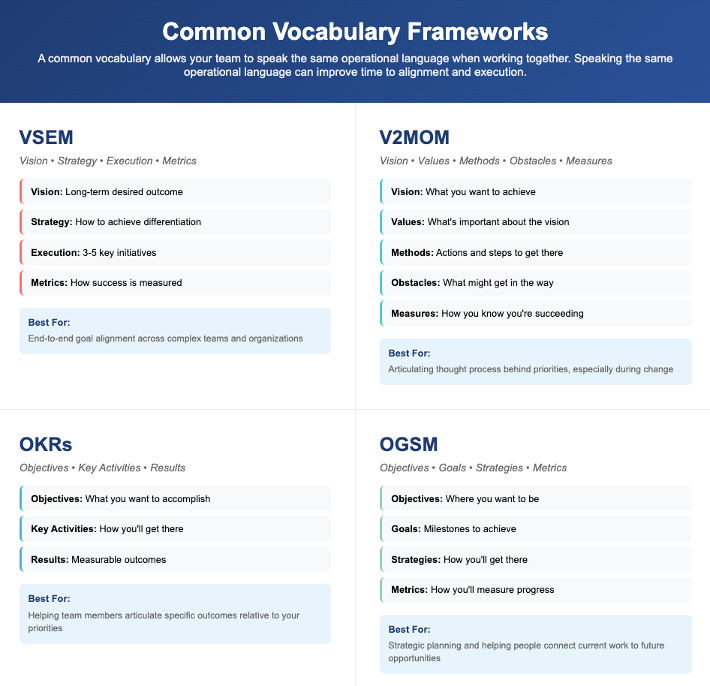
In part two of this 5-part series, I shared a number of common vocabulary options, each of which includes and requires measurement.
As a manager, the key is to align your goals to measures of success in a consistent way. Do you have a common operational language? If you don’t, pick one from these four or borrow parts from them to build you own consistent way to drive alignment on your team:
How: Publish a Goal-Metrics Matrix
To help managers with this process, I’ve developed a “Goals-Metrics Matrix” to ensure end-to-end alignment between and among priorities, goals and metrics.
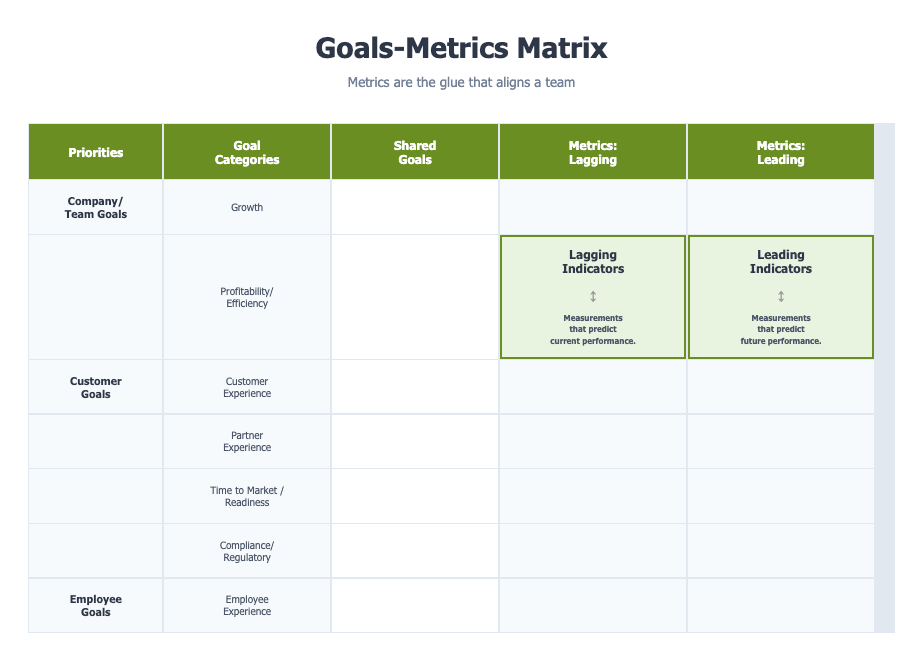
There’s an innovation in the template to help you manage in the age of uncertainty: you’ll see it includes “lagging” and “leading” indicators. Lagging indicators focus on current performance, while leading indicators focus on future performance.
The velocity of change is one of the biggest differences for managers today when compared to boomer managers. Every team today should have a handful of leading-indicator metrics — to make sure the team is focused on what’s changing, especially around AI’s impact on the team.
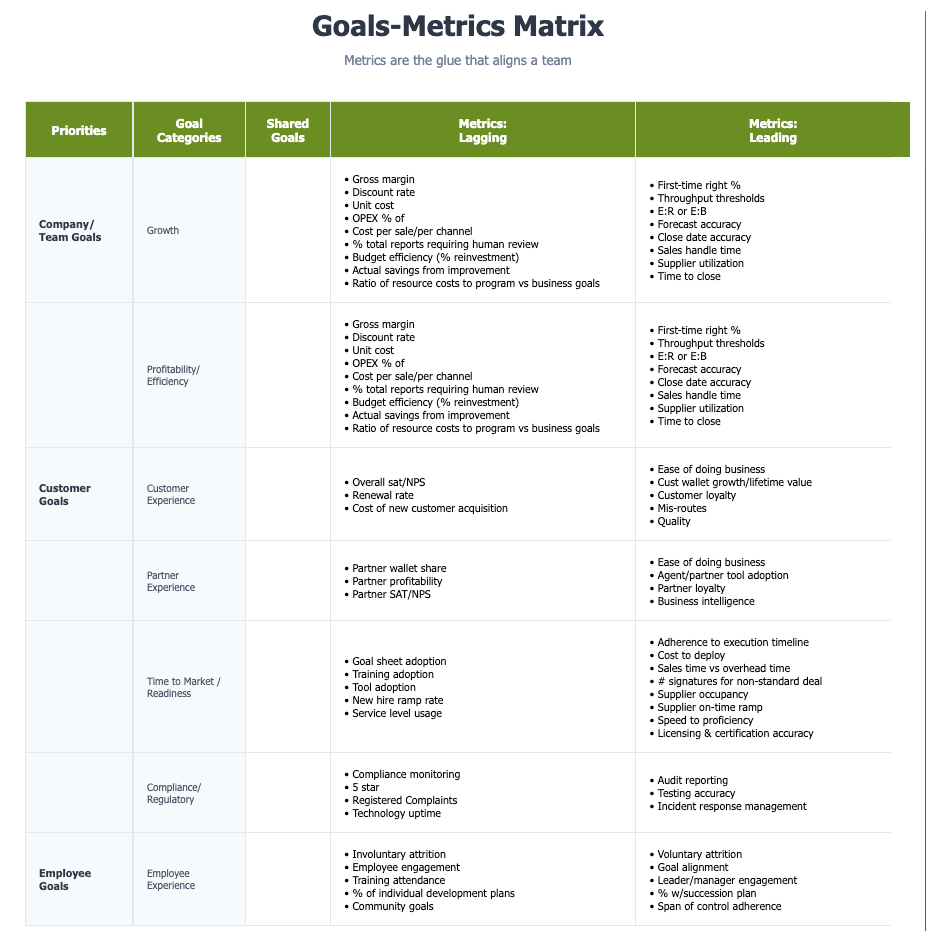
To help managers think through metrics, I’ve populated the matrix with 50+ commonly used examples of what lagging/leading metrics look like:
Homework: Find the industry benchmark
One of the lessons I learned while at Cisco is to benchmark yourself against the industry’s best, not the best in your market. When Cisco decided to focus on supply chain, it chose companies like Walmart to benchmark against — because Walmart was the global leader in supply chain outcomes. Cisco and its peers were never in the same category as organizations like Walmart.
Get outside your market space and challenge your team to be best in the world.
Bottomline: Metrics are a manager’s best friend
You will get to the next level based on how well you and your team execute, and the facts you use to prove your impact. A common set of facts on your goals-metrics matrix will give you the ammunition to show your impact — and give your people facts to help them prove their value as well.
In addition, you are likely taking several breakthrough risks around AI – you want to prove your bets are correct and how to measure productivity and impact to revenue. After all, that’s the name of the game today.
Try Career Story Builder
Recently I launched an AI-powered tool called “Career Story Builder” to provide a mentor, coach and buddy to help people write best-sellers about themselves — and why they’re ready for the next role.
Give the Career Story Builder a try. It’s free and unlimited. I’d also love to hear your feedback about how to make it better. It’s new and I’m sure it can be improved. Send me a DM with any thoughts.

In Summary: Principles of Managing in the Age of Uncertainty
I left Cisco to answer this question with research and evidence: What does the manager of the future look like? What are millennials and gen-z seeking in a manager? Which behaviors, tactics, skills or processes matter? What’s it going to take to attract and keep the best people over the next decade? In short, how to be a great manager.
Based on this research, the core philosophy of this newsletter is rooted in one idea: successful managers in this moment in time, for this generation of talent, need to be “career dot-connectors.” The next-gen doesn’t expect to spend their entire career on your team — that’s an idea boomers grew up with. A job on your team is like a chapter in a career story to the current generation. If you want the best people on your team, you have to connect the dots between roles on the team and the career opportunities of the people working on the team.
What is the“Age of Uncertainty”? If the industrial age was about taking predictable steps up the ladder, the age of uncertainty is about finding or discovering the path of a career without any predictable steps, without an obvious ladder — it’s why being a career dot-connector will differentiate you as a manager.
How to be a Great Manager in the Age of Uncertainty: Be a Career Dot Connector is available on Amazon.
What kind of manager are you? Take my free self-assessment and learn about yourself.