
Managing in the Age of Uncertainty
Welcome Managers of the World

My experience has taught me that “walking the talk” is the hardest part of managing.
The consistency between your words and actions is always be the most difficult part of the job. Setting expectations is hard. Following through is even harder.
It’s why legendary General Electric CEO Jack Welch told me to “tell the truth” if I wanted to be a great manager.
In this issue of my newsletter, I’m focusing on the top finding of my multi-year research project on the future of managing: Consistency.
Why Consistency?
The core philosophy of this newsletter is rooted in one idea: successful managers in this moment in time, for this generation of talent, need to be “career dot-connectors.”
Remember, the next-gen doesn’t expect to spend their entire career on your team — that’s an idea boomers grew up with. A job on your team is like a chapter in a career story to the current generation. If you want the best people on your team, you have to connect the dots between roles on the team and the career opportunities of the people working on the team.
But it takes consistency, according to my research. As I’ve said earlier, this isn’t a theory newsletter - I want to give you new and specific information.
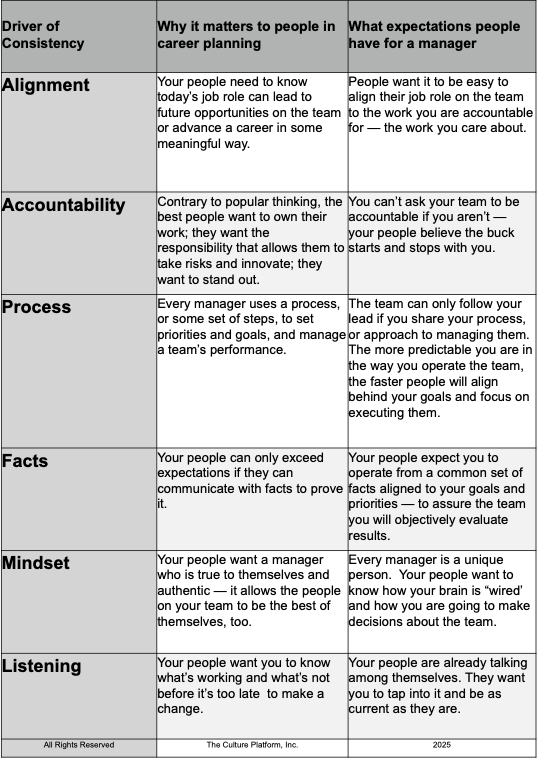
To that end, my research I identified six specific “drivers” of consistency that millennials and genz care about. In research-speak, the Six Drivers have a 95% confidence interval in predicting someone’s willingness to recommend you as a manager — exactly the outcome you want.
At the highest level, these drivers pinpoint the exact skills you’ll need to be consistent in helping to connect career dots for your people. Look at the drivers are your starting point, the baseline skillset of anyone managing in the Age of Uncertainty.
The best people are looking for managers with these skills; people want to work for a manager who is both engaged in their career growth but also runs their team in a consistent way. Passive-aggressive behavior, where you do the opposite of what you say, is anathema to the current generation of talent. Boomers spent their entire careers living under the shadow of passive-aggressive outcomes.
The best people today want to know their manager can deliver on their word — because they are betting this chapter of their career on you
You don’t have to be great at all six of the Drivers of Consistency, but you have factor all of them into the way you manage the next generation of talent.
In coming issues of this newsletter, I’ll drill down into each of the Six Drivers, and how to learn take action against them as a manager.
In this issue, I want to top-line the six drivers. As you read these, think about yourself as a manager. We all have strengths and weaknesses. You likely have instincts of where you excel when you look at the drivers or you may have already heard feedback where you could get better.
It’s a Whole New Game for Managers
I learned from feedback and my own failures that inconsistency is the enemy of being a great manager.
Earlier in my career, I wasn’t consistently accountable, and I wasn’t always the best with facts and process. It was invaluable feedback to hear. As a result of my openness to learning how to do better, I was ultimately given the opportunity to lead the largest sales enablement team at Cisco with hundreds of people and nearly $100 million annual operating budget, including data centers, sales labs and experience centers around the world.
Can you say the same about yourself? If you look at the Six Drivers of Consistency as the foundation of managing the next generation of talent, where are you?. Ask your trusted advisors for feedback on yourself. Where do you need to get better with the Six Drivers?
Manager Thought of the Week
“I never get hard work confused with results.”
What former Cisco CEO John Chambers told me when I asked her the key to being a good manager. Accountability meant everything to John. I really enjoy John’s podcast on leadership.
In Summary: Principles of Managing in the Age of Uncertainty
I left Cisco to answer this question with research and evidence: What does the manager of the future look like? What are millennials and gen-z seeking in a manager? Which behaviors, tactics, skills or processes matter? What’s it going to take to attract and keep the best people over the next decade?
Based on this research, the core philosophy of this newsletter is rooted in one idea: successful managers in this moment in time, for this generation of talent, need to be “career dot-connectors.” The next-gen doesn’t expect to spend their entire career on your team — that’s an idea boomers grew up with. A job on your team is like a chapter in a career story to the current generation. If you want the best people on your team, you have to connect the dots between roles on the team and the career opportunities of the people working on the team.
What is the“Age of Uncertainty”? If the industrial age was about taking predictable steps up the ladder, the age of uncertainty is about finding or discovering the path of a career without any predictable steps, without an obvious ladder — it’s why being a career dot-connector will differentiate you as a manager.
How to be a Great Manager in the Age of Uncertainty: Be a Career Dot Connector is available on Amazon.
What kind of manager are you? Take my free self-assessment and learn about yourself.
HI Ron !
This is powerful, motivating information. I'm not a manager of anyone or anything, other than my home and family. I think some of the ideas are certainly applicable even though I am no longer in the workforce. Thank you!