

At a time when more is changing faster than ever in the workplace, nine out of ten employees don’t actually know how things are going with all the change.
How can that be?
Seriously?
For managers, it’s a gut punch. Even in the age of AI, front-line managers have the most important job in every organization: they are responsible for getting stuff done. How can you lead a team under these conditions? How do you motivate your team?
We all know AI is reimagining work. If anything separates the boomer generation from millennials and gen-z, it is the difference of attitudes toward information flow. The current generation grew up in 24/7 communications while boomers quite figuratively had CBS, NBC and ABC.
Back in the boomer generation, keeping information “close to the vest” was considered normal. But “information is power” doesn’t work when managing millennials and gen-z, according to my research. The next generation of talent knows they won’t spend their career on the corporate ladder like their parents did. Instead, they’re charting their own course, looking to write their own career story.
Because of that, the current generation of talent needs to know the “state of play.”
I don’t think it’s a coincidence that trust in companies is at an all-time low — with only about 20 percent of employees trusting leadership where they work.
As a manager, you know the secret to your success is your people. Ultimately, the changes from AI will affect people — and whether those people can see themselves in your team’s future.
Managers are caught in the middle: between organizations that under-communicate and teams that desperately need to hear what’s happening.
What’s a Manager To Do?
Here’s what my research found about what millennials and gen-z expect from their manager: “Tell me how you’re wired.” In the absence of specific information about the progress inside the organization, people look to their manager to feel grounded and informed.
One of the Six Drivers of Consistency in my framework for Managing in the Age of Uncertainty is called: the Manager’s Mindset.
How you think and make decisions as a manager is what your team wants to know. They want you to be predictable in your behaviors.
One of my early colleagues in Silicon Valley and good friend Michelle Bowman shares her views on communication here on Substack with a newsletter called Purposefully Yours. She writes about the importance of communicating with clarity as a leader or manager in this moment in time. I asked her how managers can navigate the “middle ground” where everyone knows changes are coming but the organization isn’t saying much about them.
“Employees are jaded today,” she tells me. “They’ve heard the key messages, the company line — they need more than that from their manager.”
What’s important is this: “Be clear on your purpose as a manager,” Michelle tells me.
I love this idea: be clear on your purpose as a manager.
Think about yourself as a manager. How would you answer the question — what your purpose in your role?
Three Ways to Build Your Purpose as a Manager
“What do you want to be known for as a manager?” Michelle tells me.
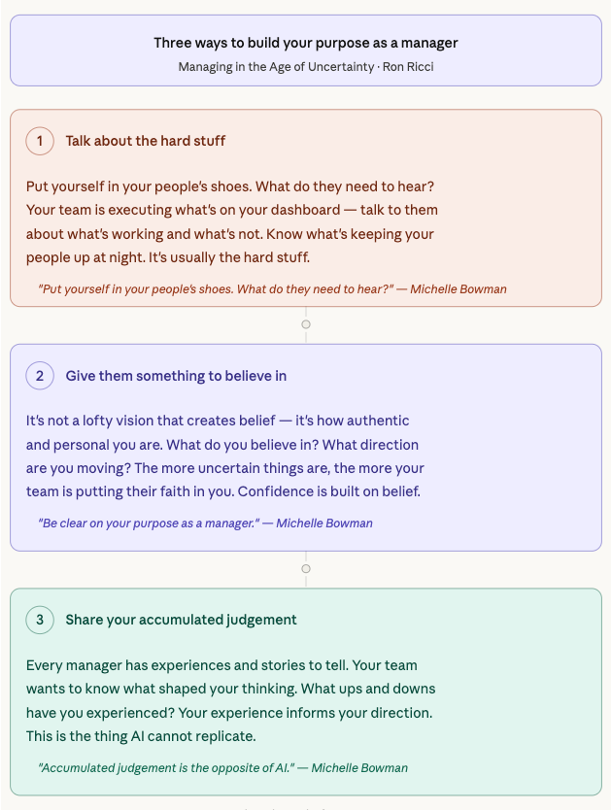
She points to three different ways managers can build purpose — for themselves and for the team:
Talk about the hard stuff. I understand why many managers wouldn’t want to talk about the hard stuff — it’s hard. “Put yourself in your people’s shoes,” Michelle says. “What do they need to hear?” People on the team are executing what’s on your dashboard. Talking to you about what’s working and what’s not working is exactly what the “hard stuff” is. As I’ve said many times here in this newsletter, every manager today needs to know what’s keeping their people up at night — it’s almost always the hard stuff.
Give your team something to believe in. Michelle has a fascinating take here: it’s not some lofty vision that creates belief, it’s “how authentic and personal you are,” she says. What do you believe in? In what direction do you think we’re moving? Those are the conversations she emphasizes are important. It really makes sense when you think about it. The more uncertain things are, the more people are putting their faith in their manager — and confidence in you is built on what you believe in.
Share your “accumulated judgement.” This is such as great phrase. All managers, even first-time managers, have experiences and stories to tell. Your team wants to know what factors shaped your thinking as a manager. What ups and downs have you experienced? “Accumulated judgement is the opposite of AI,” Michelle says. “Your experience informs your direction.”
Homework:
Before your next team meeting, share thge answers to these three questions:
What’s one hard thing happening on my team right now that I’ve been avoiding saying out loud?
In one sentence — what do I actually believe about where this team is headed?
What’s one experience from my career that shaped how I think as a manager?
If you can’t answer all three, that’s your starting point. Your team is waiting to hear from you.
In Summary: Principles of Managing in the Age of Uncertainty
I left Cisco to answer this question with research and evidence: What does the manager of the future look like? What are millennials and gen-z seeking in a manager? Which behaviors, tactics, skills or processes matter? What’s it going to take to attract and keep the best people over the next decade? In short, how to be a great manager.
Based on this research, the core philosophy of this newsletter is rooted in one idea: successful managers in this moment in time, for this generation of talent, need to be “career dot-connectors.” The next-gen doesn’t expect to spend their entire career on your team — that’s an idea boomers grew up with. A job on your team is like a chapter in a career story to the current generation. If you want the best people on your team, you have to connect the dots between roles on the team and the career opportunities of the people working on the team.
What is the“Age of Uncertainty”? If the industrial age was about taking predictable steps up the ladder, the age of uncertainty is about finding or discovering the path of a career without any predictable steps, without an obvious ladder — it’s why being a career dot-connector will differentiate you as a manager.
How to be a Great Manager in the Age of Uncertainty: Be a Career Dot Connector is available on Amazon.
What kind of manager are you? Take my free self-assessment and learn about yourself.
I like the "state of play" point, Ron, as employees/teams look to their manager for a signal that they are paying attention, and that they see what I see as an employee and respond directly.